
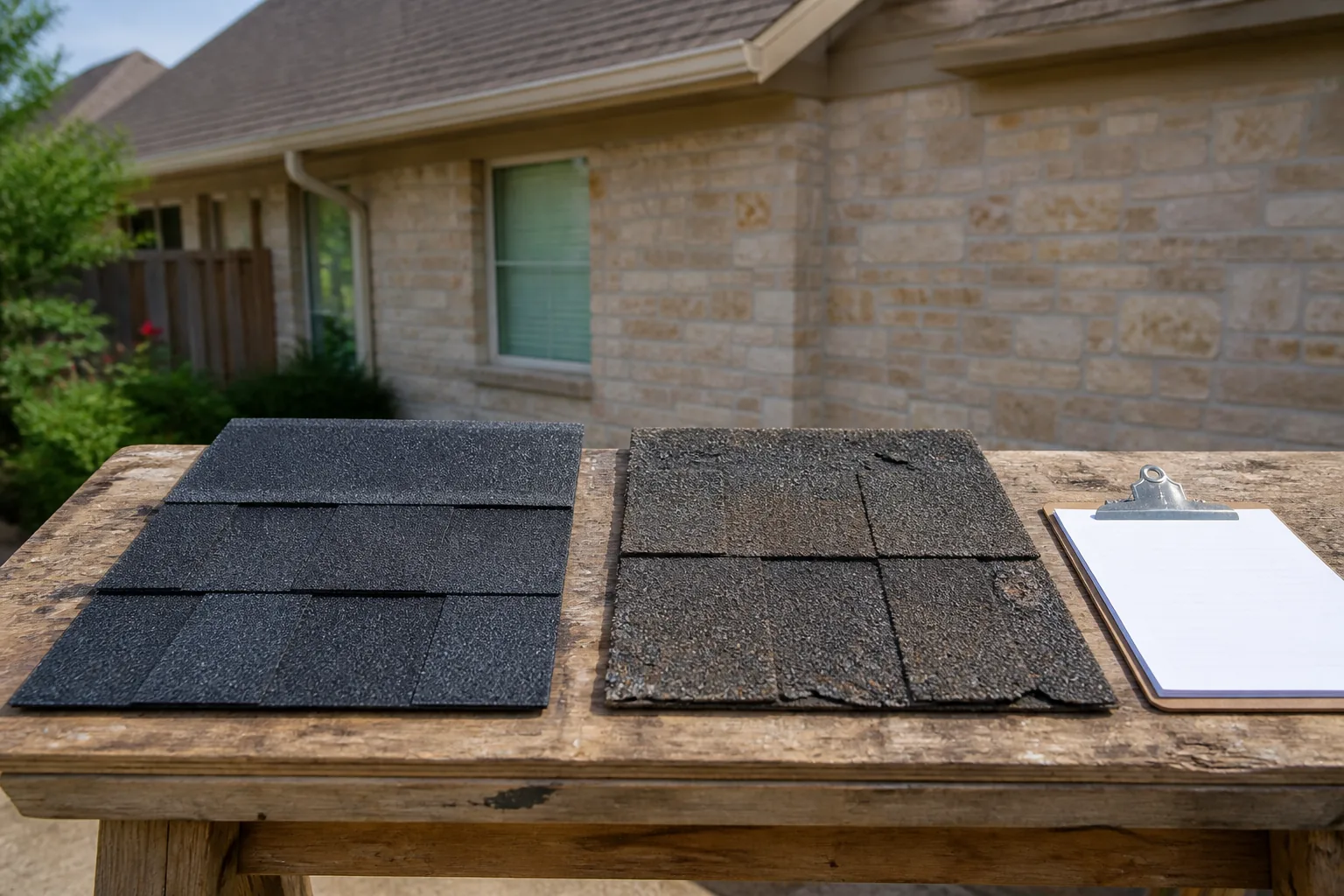
Replacement Cost vs. Actual Cash Value in Texas
Short answer: replacement cost pays what it costs to fix the damage today. Actual cash value pays that amount minus depreciation for age and wear. The premium difference is small. The claim difference can be the entire claim.
This is the single most consequential line on a Texas home policy that most homeowners never read. It does not appear in the price comparison. It does not change the coverage limit printed on the declarations page. It only shows up on the day you file a claim, and by then it is settled.
It matters more in Texas than almost anywhere else, because Texas roofs take a beating and roof claims are the most common significant property claim in the state. This guide explains how replacement cost vs actual cash value in Texas actually works, why roof coverage quietly changes at renewal, and what to verify before requesting a home insurance comparison.
The core difference
The Texas Department of Insurance frames it simply. Most home insurance policies pay to repair or rebuild your home based on current costs, which is replacement cost coverage. Some policies pay less based on the age and condition of your home, which is actual cash value coverage. Policies with actual cash value cost less, but they also pay less when you have a claim.
Depreciation is the mechanism. It is a reduction in value because of wear and age. A ten-year-old roof, a fifteen-year-old water heater, and a seven-year-old fence are all worth less than new versions of the same items, and an actual cash value policy pays the depreciated figure.
The two methods can also apply to different parts of the same policy. It is common for a Texas policy to settle the dwelling on replacement cost while settling the roof on actual cash value, or to settle the dwelling and roof on replacement cost while settling personal property on actual cash value. Do not assume one answer covers the whole contract.
What the math actually looks like
TDI publishes a worked example that is worth reading closely, because the numbers land harder than the concept does.
The scenario: a house insured for $200,000 with a 2 percent deductible, which comes to $4,000. A covered storm destroys the entire roof. The roof costs $10,000 to replace.
Under replacement cost coverage, the policy pays the same amount no matter how old the roof is:
- Cost to replace the roof: $10,000
- Minus the deductible: $4,000
- Policy pays: $6,000
Under actual cash value coverage, the payment depends on roof age:
| Roof age | Actual cash value | Minus deductible | Policy pays |
|---|---|---|---|
| 5 years | $8,500 | $4,000 | $4,500 |
| 10 years | $7,000 | $4,000 | $3,000 |
| 20 years | $4,000 | $4,000 | $0 |
That last row is the one to sit with. A homeowner with a twenty-year-old roof, an actual cash value settlement, and a 2 percent deductible files a legitimate covered claim on a completely destroyed roof and receives nothing. The claim is not denied. The math simply consumes it.
The value of your house and the amount of your deductible will differ from this example, and your policy's depreciation schedule will differ from these figures. The structure of the outcome does not.
The interaction nobody plans for: deductible plus depreciation
Notice that the twenty-year row does not fail because depreciation was severe. It fails because depreciation and the deductible stacked.
Texas wind and hail deductibles are frequently written as a percentage of the dwelling limit rather than as a flat dollar amount. That means the deductible scales with the value of the home, while the depreciated roof value scales down with age. Those two lines converge, and at some point they cross.
A useful way to think about it: on an actual cash value roof, your effective coverage is the depreciated roof value minus the deductible. As the roof ages, that number shrinks toward zero on its own, without anything changing in your policy.
Practical implications:
- A higher percentage deductible is more dangerous on an older roof. Moving from 1 percent to 2 percent to save premium can eliminate roof coverage entirely on a home with an aging roof.
- A rising dwelling limit raises a percentage deductible. Inflation guard increases the dwelling limit each year, which quietly raises the dollar deductible each year, which further narrows an actual cash value roof recovery.
- Two deductibles can apply to one storm. Some policies apply a separate wind and hail deductible on top of the all-other-perils deductible. Read the declarations page to see which applies to what.
Review the wind and hail deductible guide alongside this article, because the two settings only make sense together.
Roof coverage can change without you changing anything
This is the part that surprises homeowners most, and it is documented directly by TDI.
In its guidance on insurance and your roof, TDI advises that when you renew your policy, you should check to see if there are changes to your roof coverage. It states that as roofs age, some companies will switch to actual cash value, and that if your roof is in poor condition, the company might not cover your roof at all. The company should tell you when they change your coverage.
Read that sequence again. The trigger is age and condition, not a claim, not a lapse, not anything you did. The notification arrives inside a renewal packet. Most homeowners never open it.
The practical result is a policy that was purchased with replacement cost roof coverage in year one and settles on actual cash value in year nine, at exactly the point in the roof's life when the difference matters most.
What to do about it:
- Open the renewal declarations page every single year and compare it to last year's.
- Look specifically for a roof surfacing endorsement, a roof payment schedule, an actual cash value roof endorsement, or a windstorm roof schedule.
- If the language changed, ask your agent what it changed from and whether a different carrier will still write the roof on replacement cost.
- If your roof is approaching the age where carriers start restricting it, review the older roof insurance path before the change gets forced on you.
How replacement cost claims actually pay out
Even when you have replacement cost coverage, the money does not arrive all at once, and this catches people off guard.
TDI explains that if you have replacement cost coverage on a roof claim, the company will pay with two checks. The first check is a partial payment. The company sends the rest of your claim amount after you have started repairs.
The mechanics behind that: the first payment is generally the actual cash value amount, meaning the replacement cost less depreciation and less your deductible. The withheld portion is called recoverable depreciation. You get it once you actually complete the work and document it.
This creates real cash-flow consequences.
- You may need to fund the gap. If a $20,000 roof pays $9,000 up front, you or your contractor carry the difference until the work is documented.
- Recoverable depreciation is not automatic. It is generally released on proof of completed repairs. If you take the first check and do not repair, you typically forfeit the rest.
- There is usually a deadline. Policies commonly require the replacement to be completed within a set period after the loss. Miss it and the claim can settle permanently at actual cash value.
- Contractor selection matters. A contractor who disappears mid-job can strand the recoverable depreciation. TDI publishes guidance on hiring a contractor and avoiding storm-chasing scams, which is worth reading before signing anything after a hailstorm.
What insurance will not do, regardless of settlement method
TDI states it plainly: your insurance company will not pay for a new roof just because it is old or worn out.
Property insurance responds to sudden and accidental damage from a covered peril. It does not respond to:
- Age, granule loss, and normal weathering.
- Deferred maintenance and known unrepaired damage.
- Manufacturing defects, which belong to the product warranty.
- Poor installation, which belongs to the contractor.
- Gradual leaks that were visible over months.
This is why an aging roof is a capital planning problem, not an insurance problem, and why carriers underwrite it so aggressively. TDI notes that the insurance company will inspect your roof when you apply for coverage, and may charge more or refuse to insure you based on what they see.
Personal property is a separate decision
The replacement cost versus actual cash value choice applies to your belongings too, and it is settled separately from the dwelling.
TDI illustrates it with a laptop: if you paid $1,300 for a laptop two years ago and the same model now sells for $500, a basic actual cash value policy would pay $500 if the laptop was destroyed. Coverage that pays the replacement value of your items is available, but it costs more.
Scale that across an entire household. Furniture, clothing, electronics, appliances, and tools all depreciate quickly. On a total loss, the gap between actual cash value and replacement cost on contents is frequently tens of thousands of dollars.
Two supporting points:
- Sublimits still apply. Even on a replacement cost contents form, categories like jewelry, cash, firearms, and business property carry their own low caps unless scheduled.
- A home inventory is what makes the coverage usable. Replacement cost on contents you cannot document is theoretical. TDI publishes a home inventory tool for exactly this purpose.
Questions to ask before you buy or renew
Bring these to your agent with the declarations page in hand.
- Is the dwelling settled on replacement cost or actual cash value?
- Is the roof settled the same way as the rest of the dwelling, or is there a separate roof schedule?
- If there is a roof schedule, at what age does it begin depreciating, and by how much per year?
- Is personal property settled on replacement cost or actual cash value?
- What is my wind and hail deductible, is it a flat amount or a percentage, and of what number?
- Does a separate deductible apply to non-wind losses?
- Is there extended or guaranteed replacement cost above the dwelling limit if rebuild costs exceed the estimate?
- How long do I have after a loss to complete repairs and recover withheld depreciation?
- Did anything about my roof coverage change from last year's renewal?
- Is there an ordinance or law endorsement to cover code upgrades triggered by a rebuild?
If the answer to any of these is not visible on the declarations page, request the endorsement forms. The endorsements, not the summary, control the outcome.
Why the cheaper quote is often the wrong quote
Two Texas home quotes can look nearly identical: same dwelling limit, same liability limit, same carrier tier, a few hundred dollars apart in annual premium. One settles the roof on replacement cost. The other depreciates it on a schedule starting at year ten.
On a home that never files a roof claim, the second quote wins by the price difference. On a home that takes a hailstorm in year twelve, the second quote can pay nothing while the first pays a full roof minus the deductible.
That asymmetry is the whole argument for reading loss settlement terms. The savings are small and certain. The exposure is large and uncertain. Most Texas homeowners, given the actual numbers, price the tradeoff differently than an online quote engine does on their behalf.
If you are not sure which side of that line your current policy sits on, an independent policy review will tell you before a storm does. Argo Insurance reads the declarations page and endorsement schedule rather than the premium, and shops across carriers whose roof appetite differs, which is usually where the meaningful difference lives.
Coverage descriptions in this article are general and the examples come from TDI's published consumer guidance. Specific limits, deductibles, depreciation schedules, and settlement conditions are governed by the actual policy issued.
Related resources
How Argo can help
Not sure how this guide applies to you? A licensed Argo agent can review your situation in English or Spanish.
- Review your current policy or insurance requirement
- Explain coverage choices, limits, and deductibles
- Help you start a quote or plan the next step