
Does Auto Insurance Cover Hail Damage in Texas?
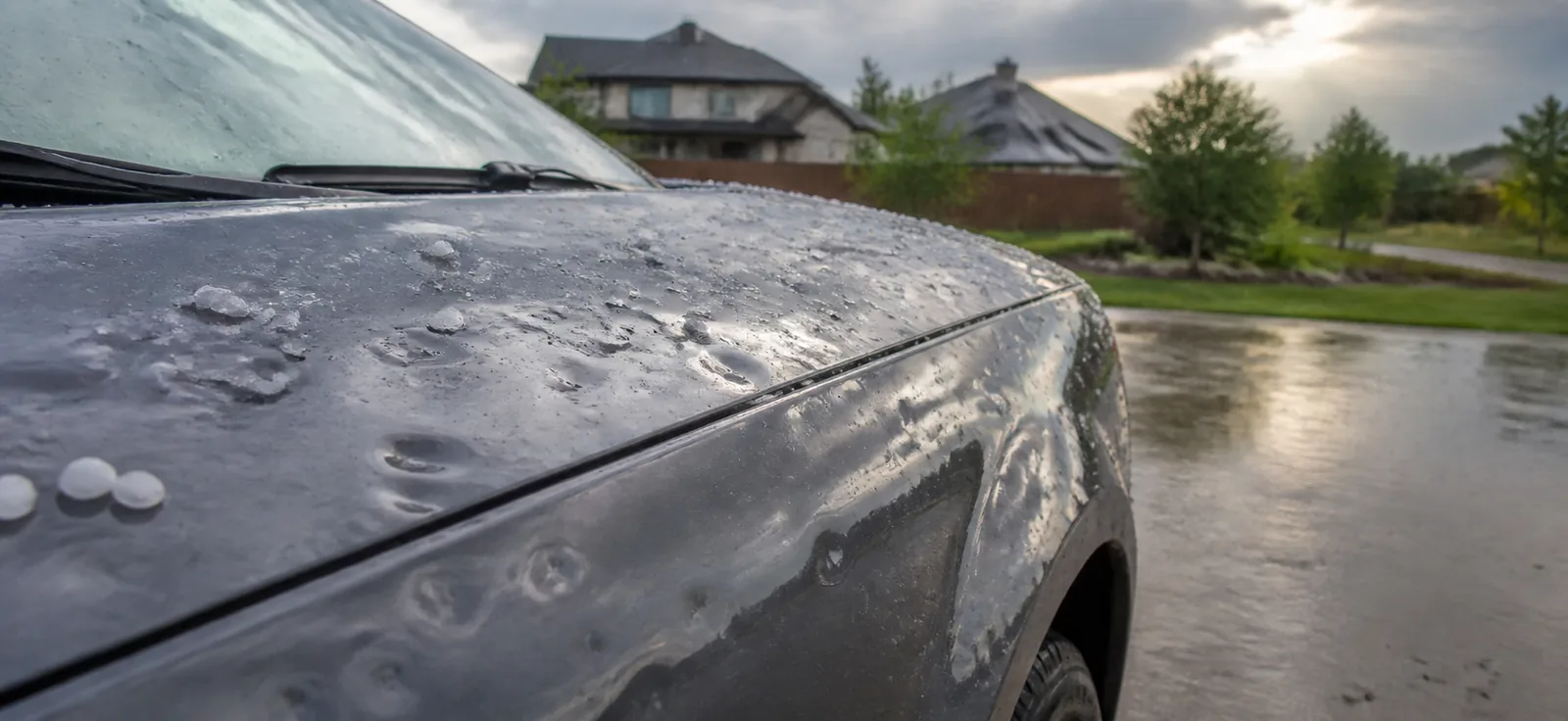
Short answer: hail damage to your car is covered by comprehensive coverage. Hail damage to your house is covered by your homeowners policy, subject to a wind and hail deductible that in Texas is frequently a percentage of your dwelling limit rather than a flat amount. Two different policies, two different deductibles, and one storm can trigger both.
Texas leads the country in hail claims. For most Texas households this is not a remote scenario, it is a question of when. Understanding which policy responds and what your deductible actually is before the storm is worth more than anything you can do after.
Hail damage to your vehicle
Comprehensive coverage is what responds. Not collision, not liability.
Comprehensive is optional under Texas law and required by any lender or lessor. If you carry liability only, hail damage to your vehicle is not covered.
Your comprehensive deductible applies. This is where many drivers discover a problem. A $2,000 comprehensive deductible on $2,400 of hail damage produces a $400 payment. In hail-prone parts of Texas, a high comprehensive deductible can effectively eliminate the coverage you are paying for.
Hail claims are generally treated as not-at-fault. A weather claim is weighted differently from a collision you caused. That does not make it consequence-free, because carriers do look at overall claim frequency, but a single hail claim is not the same as an at-fault accident.
Most repairs use paintless dent repair, which reshapes the metal without repainting. It is faster and less expensive than conventional body work and preserves the factory finish. Severe damage or dents that have cracked paint require conventional repair.
Hail totals more vehicles than people expect. Because hail damages every horizontal panel at once, the repair estimate on an older vehicle can exceed its actual cash value. If that happens you receive the vehicle's value minus your deductible, and if you owe more than that on a loan, only gap coverage closes the difference.
Hail damage to your home
Your homeowners policy responds, and the mechanics are more complicated than on the auto side.
The wind and hail deductible
Texas home policies frequently carry a separate deductible for wind and hail, distinct from the all-other-perils deductible, and it is often expressed as a percentage of the dwelling limit.
On a home insured for $400,000 with a 2 percent wind and hail deductible:
- The deductible is $8,000, not a percentage of the claim.
- A $7,200 roof repair produces no payment.
- A $30,000 roof replacement pays roughly $22,000.
Common options are 1, 2, and 5 percent. On that same home, the spread between 1 percent and 5 percent is $4,000 versus $20,000 out of pocket.
Two things make this worse over time. Inflation guard raises your dwelling limit annually, which raises the dollar deductible without anyone deciding to. And the deductible applies per event, so two hailstorms in one season means two deductibles.
Replacement cost versus actual cash value on the roof
This is the setting that determines whether a legitimate claim pays anything at all, and most homeowners have never checked it.
TDI publishes a worked example. On a house insured for $200,000 with a 2 percent deductible of $4,000, where a storm destroys the entire roof and replacement costs $10,000:
Under replacement cost coverage, the policy pays $6,000 regardless of the roof's age.
Under actual cash value coverage, the payment depends on age:
| Roof age | Actual cash value | Minus deductible | Policy pays |
|---|---|---|---|
| 5 years | $8,500 | $4,000 | $4,500 |
| 10 years | $7,000 | $4,000 | $3,000 |
| 20 years | $4,000 | $4,000 | $0 |
That last row is not a denial. The claim is covered. Depreciation and the deductible simply consume it entirely.
Coverage can change without you doing anything
TDI advises checking for changes to roof coverage at each renewal, and notes that as roofs age, some companies will switch to actual cash value, and that if a roof is in poor condition the company might not cover it at all. The company should tell you when they change your coverage.
The trigger is age and condition, not anything you did. The notice arrives inside a renewal packet most people never open. That is how a homeowner ends up with replacement cost coverage in year one and actual cash value in year nine, at exactly the point in the roof's life when it matters most.
Two checks, not one
When a replacement cost roof claim pays, TDI explains the company pays with two checks. The first is a partial payment. The balance, called recoverable depreciation, is sent after you have started repairs.
Practical consequences: you or your contractor carry the gap until work is documented, the withheld amount is generally forfeited if you never repair, and policies usually impose a deadline for completing the work.
What insurance will not do
TDI states it plainly: your insurance company will not pay for a new roof just because it is old or worn out. Policies respond to sudden accidental damage, not to age, granule loss, or deferred maintenance.
After a Texas hailstorm
Document before anything changes. Photograph the vehicle and the property in good light from multiple angles. Note the storm date. On a roof, photograph from the ground and from gutters if safe. Do not climb onto a damaged roof.
Make reasonable emergency repairs to prevent further damage, and keep receipts. Tarping is expected. Do not begin permanent repairs before the adjuster inspects.
Report promptly. Adjuster availability tightens fast after a regional event, and early reporters get inspected sooner.
File with each policy separately. Your auto claim and your home claim are separate, with separate adjusters and separate deductibles. Filing one does not notify the other.
Be careful with storm chasers. Roofing and repair operations appear in affected neighborhoods within days. TDI publishes guidance on hiring a contractor and avoiding scams. Verify the contractor, get the scope in writing, be wary of anyone offering to absorb your deductible, and understand exactly what you are signing before assigning any claim benefits.
Expect delays. After a widespread storm, adjusters, contractors, and materials are all constrained at once. This is when rental reimbursement on auto and additional living expense on home earn their cost.
Before the next storm
Six things worth doing while the sky is clear.
- Find your wind and hail deductible and convert it to dollars. Never leave it as a percentage in your head.
- Find out whether your roof is settled at replacement cost or on a depreciation schedule, and at what age that changes.
- Compare this year's declarations page to last year's to catch a silent coverage change.
- Check your comprehensive deductible on every vehicle.
- Photograph your roof and vehicles annually, so you have dated evidence of pre-storm condition.
- Know where you will park. Texas storm warnings usually give hours of notice, and a garage or parking structure is the most effective protection available. Ordinary car covers do not stop hail.
Whether to file at all
Not every hail claim is worth filing, and the deductible does most of the deciding.
On a vehicle. Get a repair estimate first. If the estimate is close to or below your comprehensive deductible, there is little to recover. Cosmetic dents on an older vehicle you plan to keep may not justify a recorded claim. Significant damage, cracked glass, or anything affecting the roof or windshield generally should be filed.
On a home. Get a roof inspection from a reputable contractor, ideally one you found before the storm rather than one who knocked on your door after it. Compare the estimate to your wind and hail deductible in dollars. Below the deductible there is no claim to make, and a claim filed and closed without payment can still appear in your claim history.
A caution on frequency. Property claim history follows the address through reporting databases, and multiple claims can affect renewal, eligibility, and pricing for years. That is not a reason to skip a legitimate large claim. It is a reason to think carefully about small ones.
Preventing the damage in the first place
Insurance pays after. These reduce how often you need it.
Vehicles. Texas storm warnings typically give hours of notice. A garage, carport, or parking structure is the single most effective protection. Purpose-built hail blankets work; ordinary car covers do not. If you are caught driving, an overpass or a covered fuel station canopy is better than open road, though pulling over safely matters more than finding cover.
Roofs. Impact-resistant shingles, rated Class 4, resist hail better than standard asphalt shingles, and many Texas carriers offer a premium discount for them. If you are replacing a roof anyway, the incremental cost is often modest relative to the discount plus the reduced claim likelihood.
Maintenance. TDI notes that insurers inspect roofs at application and may charge more or decline based on condition. Keeping tree limbs trimmed back, gutters clear, and loose or missing shingles repaired protects both your eligibility and your roof.
Documentation. Photograph your roof and vehicles annually in good condition. It costs ten minutes and it eliminates arguments about pre-existing damage.
Hail damage to other property
Vehicles and roofs get the attention. Hail damages other things too, and coverage varies.
Fences. Generally covered under other structures on a homeowners policy, subject to the same wind and hail deductible. Because fence damage alone rarely exceeds a percentage deductible, it frequently produces no payment on its own but can be included in a larger claim.
Detached garages and sheds. Other structures coverage, usually limited to a percentage of the dwelling limit.
HVAC condenser units. Hail damages condenser fins, and this is frequently overlooked in claim scopes. Ask the adjuster to inspect the outdoor unit specifically.
Windows, screens, and siding. Covered, though cosmetic damage to some materials can be excluded or disputed.
Gutters, soffit, and fascia. Commonly damaged and commonly missed in initial estimates.
Solar panels. Usually covered if permanently attached and scheduled, and worth confirming rather than assuming.
Boats, RVs, and trailers. These need their own policies. They are not covered by your home or auto policy, and an RV parked in the driveway during a hailstorm is one of the more expensive uncovered losses people discover.
Metal roofs. Some policies contain a cosmetic damage exclusion for metal roofing, which covers functional damage but not dents that do not affect performance. If you have a metal roof, check for this exclusion specifically.
Building the scope correctly
The most common claim problem after a Texas hailstorm is not denial. It is an initial estimate that misses damage.
- Walk the property with the adjuster if you can, and point out everything, including the HVAC unit, fences, screens, and gutters.
- Get your own contractor estimate before or alongside the adjuster's inspection so you have a comparison.
- Ask for the estimate in writing and read every line.
- Supplements are normal. If your contractor finds damage during repair that the estimate missed, they submit a supplement. This is routine.
- If you disagree on the amount, many policies contain an appraisal clause allowing each side to appoint an appraiser to resolve valuation disputes without litigation. It addresses amount, not coverage.
The combination that causes the most damage
An aging roof, a percentage deductible, and actual cash value settlement together produce the outcome homeowners describe as their insurance failing them.
It usually did not fail. It performed exactly as those three settings specified. The problem is that all three are on the declarations page and almost nobody reads it until after a storm.
If you do not know what your wind and hail deductible is in dollars, or whether your roof is settled at replacement cost, request a Home policy review. We can convert the percentage into a dollar amount and explain the settlement terms shown on your declarations page.
Related resources
How Argo can help
Not sure how this guide applies to you? A licensed Argo agent can review your situation in English or Spanish.
- Review your current policy or insurance requirement
- Explain coverage choices, limits, and deductibles
- Help you start a quote or plan the next step