
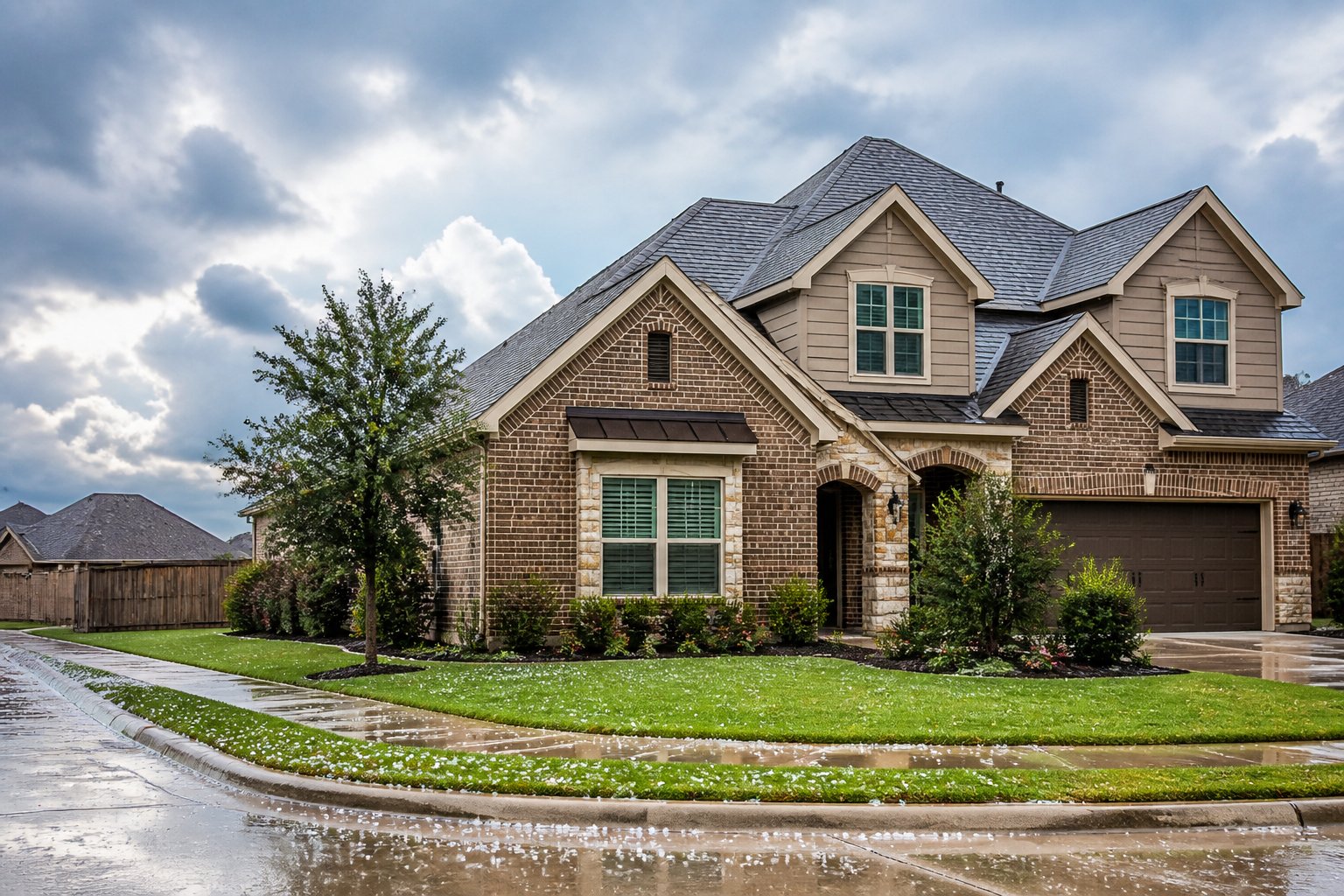
Texas Wind and Hail Deductibles: A Homeowner Guide
Short answer: a Texas wind and hail deductible is the portion of a covered storm loss the homeowner must absorb before the insurer pays. It may be a flat dollar amount or a percentage. When it is a percentage, the calculation is commonly based on the dwelling coverage limit shown on the declarations page, not on the roof repair bill or the home's market value.
That distinction can turn a number that looks small into a large out-of-pocket expense. A 2% wind and hail deductible on a home insured for $400,000 is $8,000. The same 2% deductible on a $600,000 dwelling limit is $12,000.
The percentage is only one part of the decision. A homeowner should also confirm whether wind and hail are covered by the home policy, whether a named-storm or hurricane deductible can apply, and whether the roof is settled at replacement cost or actual cash value. The declarations page, policy form, and endorsements control the answer for a specific property.
This guide explains how to review those items before requesting a Texas wind and hail insurance comparison.
If you are also checking the dwelling, personal property, liability, and temporary-living-expense limits, use the companion guide on how much homeowners insurance you may need.
What is a homeowners insurance deductible?
A deductible is the amount subtracted from a covered property claim before the insurance company pays its share. Unlike a health insurance deductible that can accumulate during a plan year, a home insurance deductible generally applies to each claim.
Texas home policies can show more than one deductible. Depending on the company, location, policy form, and endorsements, the declarations page may list:
- An all-other-perils deductible for covered losses such as fire, theft, or certain water damage.
- A separate wind and hail deductible.
- A hurricane, tropical cyclone, or named-storm deductible.
- A separate deductible for another specific cause of loss.
Do not assume the largest or most visible number is the only deductible. Match each deductible to the cause of loss described next to it. If the wording is unclear, ask the agent to show where the deductible appears in the declarations and when it applies.
The Texas Department of Insurance deductible guide recommends translating every percentage into dollars and choosing an amount the household could afford after a loss.
How a percentage wind and hail deductible works
A percentage deductible is not normally a percentage of the claim. It is commonly calculated from the insured dwelling amount, often called Coverage A, although the policy must be checked for the exact basis.
Use this calculation when the policy states that the percentage applies to the dwelling limit:
Dwelling coverage × deductible percentage = deductible amount
| Dwelling coverage | 1% deductible | 2% deductible | 5% deductible |
|---|---|---|---|
| $250,000 | $2,500 | $5,000 | $12,500 |
| $400,000 | $4,000 | $8,000 | $20,000 |
| $600,000 | $6,000 | $12,000 | $30,000 |
These examples are educational, not a promise that every carrier offers those choices. The actual percentage, calculation base, minimum deductible, and covered cause of loss come from the quote and policy.
If a covered hailstorm causes $14,000 in damage to a home with a $400,000 dwelling limit and a 2% deductible, the deductible would be $8,000 under that calculation. The maximum payment based only on those two figures would be $6,000. Coverage limits, depreciation, exclusions, matching terms, and the approved repair estimate can change the final result.
If the covered repair amount is below the deductible, there may be no claim payment. That does not automatically mean the loss was uncovered. It can mean that covered damage did not exceed the homeowner's share.
All-other-perils, wind and hail, and named-storm deductibles
These labels answer different questions, and policies do not use them identically.
All-other-perils deductible
An all-other-perils deductible can apply to covered losses that do not fall into a separately listed category. It may be a flat dollar amount, but that is not universal. A declarations page might show an all-other-perils deductible beside a separate wind and hail percentage.
Wind and hail deductible
A wind and hail deductible generally applies when covered damage is caused by wind or hail. That can include damage associated with a thunderstorm, tornado, or hurricane, depending on the policy wording. It may apply to the roof and to other covered property damaged by the same event.
Hurricane or named-storm deductible
Some policies separately define a hurricane, tropical cyclone, or named-storm deductible. The trigger can depend on the storm's designation, timing, and policy language. Do not treat “wind and hail” and “named storm” as interchangeable without reading the definitions.
Ask which deductible would apply to straight-line wind, ordinary hail, a tornado, and a named hurricane. The answer should come from the written quote or policy, not a verbal shortcut.
Is wind and hail coverage included everywhere in Texas?
Location matters. According to the Texas Department of Insurance windstorm guide, homeowners outside the coast probably have wind and hail included in their homeowners policy, although a different windstorm deductible may apply.
Along parts of the Texas coast, a homeowners policy might exclude wind and hail. The property owner may need a separate windstorm policy from a private insurer or the Texas Windstorm Insurance Association. TWIA eligibility depends on the property's location, a private-market declination, underwriting requirements, and applicable inspection or certificate rules.
For Houston-area property, the exact address matters. Parts of Harris County east of Highway 146 fall within the designated catastrophe area, while most inland Houston-area homes follow the private homeowners market. A Houston wind and hail insurance review should confirm which policy is expected to respond before comparing deductibles.
Wind and hail coverage is also separate from flood insurance. Wind-driven damage and rising-water flooding can involve different policies and different claims. The Texas flood insurance guide explains that distinction.
The roof settlement method can matter as much as the deductible
Two policies can show the same wind and hail deductible but produce different roof-claim results. The key question is whether the roof is covered at replacement cost, actual cash value, or under a roof payment schedule.
Replacement-cost coverage generally uses the current cost to repair or replace covered damage, subject to the policy. Actual cash value subtracts depreciation for age and condition. Some carriers change the roof settlement method as the roof ages, and a roof in poor condition may be restricted or excluded.
The TDI replacement-cost and actual-cash-value example uses a home insured for $200,000 with a 2% deductible, which equals $4,000. For a covered roof replacement costing $10,000, the replacement-cost illustration produces $6,000 after the deductible. In TDI's actual-cash-value illustration, depreciation reduces a 20-year-old roof to $4,000, leaving no payment after the same $4,000 deductible.
That example shows why premium and deductible are not enough for comparison. Ask:
- Is the roof covered at replacement cost or actual cash value?
- Does a roof payment schedule apply?
- Does the roof's age or material change the settlement terms?
- Is cosmetic hail damage excluded or limited?
- Will the company pay recoverable depreciation after repairs begin?
- Could the policy pay for only the damaged area rather than an entire roof?
The older-roof homeowners insurance guide provides a focused path for properties with aging shingles, prior repairs, or inspection concerns.
A higher deductible is not automatically the better value
A higher deductible generally reduces the insurance premium because the homeowner keeps more of the risk. The amount saved varies by insurer and property, so do not assume that moving from 1% to 2% creates a specific discount.
Compare the actual annual savings with the additional amount you would pay after a claim. On a $400,000 dwelling limit, moving from a 1% to a 2% deductible increases the homeowner's share from $4,000 to $8,000. If the premium difference is modest, the lower deductible may provide better protection for a household that could not comfortably produce the extra $4,000 after a storm.
Also consider that the dwelling limit can change at renewal as reconstruction costs change. If a percentage stays the same while Coverage A increases, the dollar deductible increases too. Recalculate it every year instead of relying on the amount from an older declarations page.
What to do before storm season or renewal
Reviewing coverage before the forecast turns urgent provides more options. Use this checklist:
- Find the declarations page and list every property deductible.
- Convert each percentage deductible into dollars using the stated calculation base.
- Confirm whether wind and hail are included, excluded, or insured separately.
- Check for a hurricane, tropical cyclone, or named-storm deductible.
- Confirm the roof age, material, condition, and settlement basis.
- Review Coverage A to make sure the deductible calculation uses a current dwelling limit.
- Ask whether special roof endorsements, schedules, or cosmetic-damage limitations apply.
- Determine whether the household could pay the deductible promptly after a loss.
- Keep current exterior and roof photos with the policy documents.
- Compare the entire policy, not only the monthly or annual premium.
If the home is being purchased or renewed, request the full quote and deductible details early. Coastal wind coverage can involve separate eligibility steps, and TDI notes that TWIA coverage cannot be purchased when a hurricane is in the Gulf of Mexico.
For an existing policy, an insurance policy review can organize the declarations, deductibles, roof endorsements, and renewal changes before the deadline.
What to do after wind or hail damages the home
Safety comes first. After conditions are safe, document the affected roof, siding, windows, fence, and other property with photos or video. Contact the insurer or agent promptly and ask which policy and deductible apply.
The TDI hail and windstorm guidance recommends protecting the property from additional damage, keeping receipts, comparing more than one contractor bid, and avoiding permanent repairs before the insurer has an opportunity to inspect.
Do not let a contractor promise to “handle the claim” as if the contractor were the insurer or your licensed public adjuster. Read every agreement, avoid blank spaces, and keep proof of payment.
It is illegal for a Texas contractor to waive, rebate, or absorb a property insurance deductible. TDI's deductible-waiver guidance also explains that an insurance company may ask for proof that the policyholder paid the deductible.
Texas wind and hail deductible questions
How is a wind and hail deductible calculated in Texas?
If the deductible is a percentage, it is commonly calculated from the dwelling coverage limit shown on the declarations page, not from the repair estimate. The policy controls the exact calculation and the losses to which it applies.
Does a 1% wind and hail deductible mean I pay $1,000?
Not necessarily. A 1% deductible on a $400,000 dwelling limit would be $4,000. Convert the percentage using the insured amount stated in your policy.
Does the wind and hail deductible apply to every storm claim?
A property deductible is generally applied to each covered claim, but policies can define wind, hail, hurricane, named-storm, and other deductibles differently. Read the declarations and endorsements for the specific policy.
Does homeowners insurance cover wind and hail everywhere in Texas?
Many inland Texas home policies include wind and hail coverage, sometimes with a separate deductible. Along parts of the coast, the home policy may exclude wind and hail, requiring separate coverage through a private insurer or TWIA.
Can a Texas roofer waive my homeowners insurance deductible?
No. The Texas Department of Insurance states that it is illegal for a contractor to waive, rebate, or absorb a property insurance deductible. An insurer may request proof that the policyholder paid it.
Official resources used for this guide
- Texas Department of Insurance: What to know about deductibles
- Texas Department of Insurance: What is windstorm insurance?
- Texas Department of Insurance: Insurance and your roof
- Texas Department of Insurance: Replacement cost or actual cash value
- Texas Department of Insurance: Hail damage, what to do next
- Texas Department of Insurance: Contractor deductible waivers
These sources explain general Texas insurance concepts. The issued declarations, policy form, endorsements, exclusions, claim facts, and insurer decision control coverage for a specific home.
Review the deductible before choosing the policy
The right wind and hail deductible is not simply the lowest percentage or the cheapest premium. It is the amount your household can reasonably handle, attached to coverage that fits the property's location, roof, and storm exposure.
Argo Insurance is a licensed independent Texas insurance agency appointed with 74+ carriers. Availability depends on the property, location, roof, underwriting, and current market appetite. We can compare the written deductible, roof settlement terms, wind coverage, and related policy details before you choose.
Related resources
How Argo can help
Not sure how this guide applies to you? A licensed Argo agent can review your situation in English or Spanish.
- Review your current policy or insurance requirement
- Explain coverage choices, limits, and deductibles
- Help you start a quote or plan the next step