
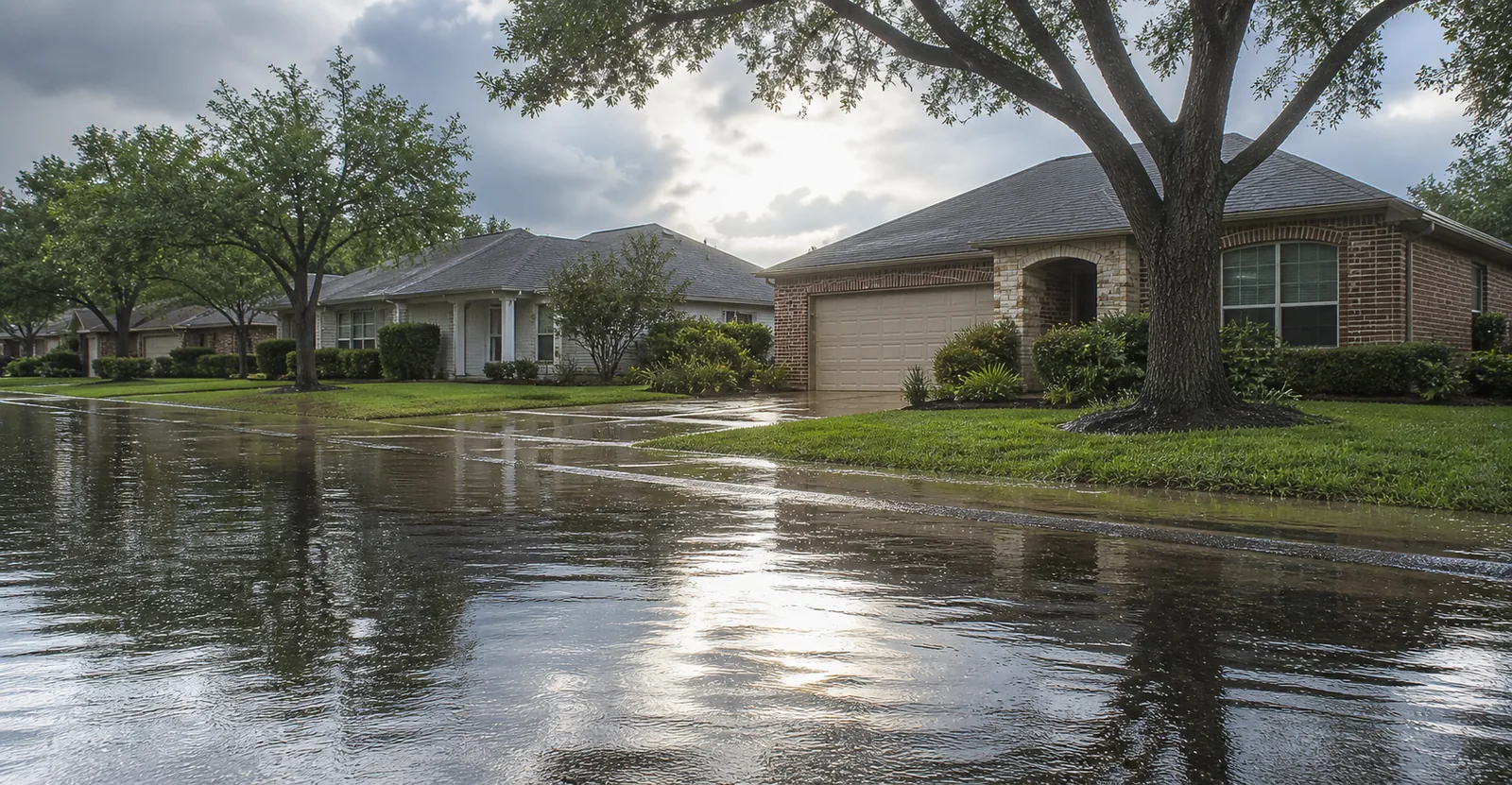
Does Home Insurance Cover Flooding in Houston?
Short answer: most standard homeowners policies do not cover direct damage caused by rising surface water. Houston homeowners generally need a separate flood policy if they want protection for water that enters from street flooding, overflowing drainage, a bayou, or storm surge.
That distinction matters because a house can face several kinds of water damage, and the cause of the loss, not simply the presence of water, usually determines which policy may respond. The Texas Department of Insurance explains that home insurance does not cover flood damage, while the federal National Flood Insurance Program, or NFIP, provides separate building and contents coverage.
This guide explains the practical differences, the NFIP limits and waiting period, questions to ask when comparing private flood coverage, and what to gather before requesting a Houston flood insurance review.
What counts as flood damage?
For insurance purposes, “flood” is more specific than everyday language. It generally involves water covering normally dry land and affecting multiple properties or a qualifying area. Common Houston examples can include:
- Water flowing into a home after a bayou, creek, or drainage channel overflows.
- Street water entering a house during prolonged or intense rainfall.
- Storm surge moving inland from the coast.
- Surface water collecting and moving across normally dry ground.
A standard homeowners policy may cover some other water losses, depending on the policy language and cause. For example, sudden accidental discharge from a plumbing system may be treated differently from flood water. Rain entering through an opening created by a covered wind event may also be evaluated differently. Sewer or drain backup can require a separate endorsement and should not be assumed to be flood coverage.
The safe question is not, “Was there water?” It is, “Where did the water come from, and what does each policy say?” Review the declarations, exclusions, deductibles, and endorsements for your specific policy rather than relying on a general label.
Why a few inches of water can become expensive
Water can damage flooring, drywall, insulation, cabinets, electrical components, appliances, and personal belongings. Cleanup can also require water removal, drying, and mold prevention. The Texas Department of Insurance notes that one inch of flood water can cause about $25,000 in damage.
That figure is an illustration, not a prediction for every home. The actual cost depends on the depth and duration of the water, the size and construction of the house, the materials affected, and what can be cleaned instead of replaced. It does show why a homeowner should compare the possible loss with the coverage and deductible, not evaluate a flood option by premium alone.
NFIP building and contents coverage are separate
The NFIP is a federal program managed by FEMA and sold through participating insurance companies and agents. For a one-to-four-family residential property, the NFIP currently offers up to $250,000 of building coverage and up to $100,000 of contents coverage.
Those are two separate coverage choices:
- Building coverage can apply to the insured structure and certain permanently installed property, subject to the policy terms.
- Contents coverage can apply to covered belongings inside the home, subject to its own limit and policy terms.
Buying building coverage does not automatically insure the contents. The NFIP also states that building and contents coverage have separate deductibles. A homeowner comparing options should ask to see each limit and deductible in writing.
NFIP coverage also has important limits and exclusions. For example, the program says it does not cover vehicles or temporary living expenses such as a hotel while a home is uninhabitable. Coverage for property in basements and other below-ground areas is limited. Read the policy and ask specific questions about any feature that matters to your household.
NFIP and private flood options are not identical
Some homeowners compare an NFIP policy with private flood coverage. Private policy limits, deductibles, eligibility rules, waiting periods, claim terms, and additional coverages vary by insurer. Some options may offer features or limits beyond the NFIP form, but that should be confirmed in the actual quote and policy, not assumed from a general description.
When comparing two flood quotes, place these items side by side:
- Building limit and how the home value was determined.
- Contents limit and whether contents are included at all.
- Building and contents deductibles.
- Waiting period and effective date.
- Loss-settlement terms.
- Temporary-living-expense coverage, if any.
- Basement, enclosure, pool, detached-structure, and outdoor-property limitations.
- Exclusions and conditions that could affect the property.
A lower price is not automatically the better fit. The useful comparison is price and the protection shown in the policy documents.
Plan around the NFIP waiting period
An NFIP policy usually takes effect 30 days after purchase. FEMA lists limited exceptions, including certain purchases connected to making, increasing, extending, or renewing a mortgage loan and some cases following a flood-map revision. A private policy may use a different waiting period, but its effective date must be confirmed with that insurer.
The practical lesson is simple: do not wait for a named storm or a week of heavy rain to begin comparing coverage. Ask for the exact effective date before paying, and keep written confirmation of when protection begins. Coverage that has been quoted or paid for is not useful for a loss that occurs before the policy becomes effective.
If a home purchase or refinance creates a tight deadline, tell the agent and lender early. The timing and reason for the purchase can affect whether an NFIP exception applies, and the mortgage company may have its own proof-of-insurance requirements.
A flood-zone label does not answer every risk question
A lender may require flood insurance when a mortgaged property is in a designated high-risk flood area. If the lender does not require it, that does not mean the property has no flood exposure. The Texas Department of Insurance reports that more than half of the homes flooded by Hurricane Harvey were outside designated flood zones. TDI also cautions that maps can become outdated as development changes how water drains.
Use FEMA's linked map resources as one part of the review, then consider the property's actual history and surroundings. Useful questions include:
- Has the house, garage, street, or nearby block flooded before?
- Is the property close to a bayou, creek, reservoir, detention basin, or drainage channel?
- Has nearby construction changed drainage or added more paved surface?
- What is the elevation of the finished floor relative to the street and nearby land?
- Does the seller have a flood disclosure, prior claim information, an elevation certificate, or a survey?
- What does the current FEMA flood map show, and when was it last revised?
No single answer predicts whether a home will flood. Together, these details can help a homeowner make a more informed coverage decision.
What affects a flood insurance quote?
Flood pricing is property-specific. Depending on the program and insurer, a quote may consider the home's location, construction, occupancy, foundation, elevation or distance from water, replacement cost, prior flood losses, selected limits, and deductibles. Eligibility and required documentation can also differ.
Because the inputs matter, a generic price shown online may have little value for a particular Houston house. A useful quote should identify the property, the coverage form, the limits, the deductibles, and the effective date.
Information to gather before requesting a quote
You do not need to know every construction detail before calling. Start with what is available:
- Property address and whether it is a primary home, rental, or secondary home.
- Current homeowners declarations page.
- Estimated rebuild value or dwelling limit.
- Desired building and contents limits.
- Foundation type and number of floors.
- Year built and major renovations.
- Prior flood history or flood claims, if any.
- Mortgage lender information and closing date, when applicable.
- Elevation certificate, survey, or flood-zone documentation, if available.
An agent may need more information after reviewing the property, but this list is enough to begin a meaningful comparison. If you are buying a home, the home insurance closing checklist can also help organize the lender and property details needed for the broader homeowners review.
Houston flood insurance questions
Does homeowners insurance cover flood damage in Houston?
Most standard homeowners policies do not cover direct damage from rising surface water. A separate flood policy is generally needed for that risk. Other water losses can be handled differently, so the cause of the water and the specific policy wording matter.
Do I need flood insurance if my lender does not require it?
A lender requirement is not the same as a complete risk assessment. Texas regulators note that more than half of homes flooded by Hurricane Harvey were outside designated flood zones. Review the property's location, history, drainage, map information, and the financial loss you could absorb.
How long does NFIP flood coverage take to start?
NFIP policies usually have a 30-day waiting period. FEMA lists limited exceptions, such as certain loan-related purchases and some flood-map revisions. Confirm the applicable effective date before assuming coverage has started.
Does one NFIP limit cover both my house and belongings?
No. NFIP building and contents coverage are purchased separately, have separate limits, and generally carry separate deductibles. Ask for both choices to be shown clearly on the quote.
Official resources used for this guide
- Texas Department of Insurance: Flood insurance
- Texas Department of Insurance: Why consider a flood policy
- FloodSmart.gov: Buying an NFIP policy
These public resources explain general flood-insurance rules. Your declarations, endorsements, quote, and policy form control the coverage for your property.
What a flood claim actually involves
Flood claims run differently from other property claims, and knowing the process in advance matters because the deadlines are strict.
Document before cleanup. Photograph and video everything, including the high water line on walls, before removing anything. Water lines are the primary evidence of depth and of whether damage came from rising water or from wind-driven rain.
Separate your claims. A storm that causes both wind and flood damage produces two claims to two different carriers with two deductibles. Filing one does not notify the other, and the two adjusters may attribute the same damage to each other's peril. Thorough documentation is your leverage in that dispute.
Watch the proof of loss deadline. NFIP policies carry a proof of loss requirement with a defined window. Missing it can jeopardize the claim regardless of how valid it is.
Understand what contents coverage does and does not include. NFIP contents coverage has category limitations, and items in a basement or below the lowest elevated floor are treated restrictively.
Expect timeline pressure after a regional event. A widespread flood generates enormous claim volume simultaneously, which stretches adjuster availability, contractor availability, and material lead times.
Keep receipts for everything, including cleanup, temporary repairs, and disposal.
Common Houston-area misconceptions
"My house has never flooded, so I do not need it." Drainage changes, development upstream changes runoff, and flood maps are updated. A large share of flood claims come from properties outside high-risk zones.
"I am not in a flood zone." Every property is in a flood zone. Some are simply lower risk than others. Zone X is a flood zone.
"My homeowners policy covers water damage." It covers certain water damage from plumbing failures. It excludes rising water from outside the structure. Those are different perils with different policies.
"My lender did not require it, so I do not need it." Lender requirements are based on mapped zones and protect the lender's interest, not your equity or your belongings.
"I will buy it when a storm is coming." There is generally a 30-day waiting period before NFIP coverage takes effect. Buying during hurricane season with a storm in the Gulf is too late.
Review the home and flood coverage together
Flood insurance solves a different problem than a standard home policy. Reviewing the two together helps identify which water risks belong to which policy and whether the limits and deductibles fit the house.
Argo Insurance is a licensed Texas insurance agency serving Houston-area homeowners. We can compare available flood options and explain the quoted limits, deductibles, waiting period, and effective date without requiring you to guess which details matter first.
Related resources
How Argo can help
Not sure how this guide applies to you? A licensed Argo agent can review your situation in English or Spanish.
- Review your current policy or insurance requirement
- Explain coverage choices, limits, and deductibles
- Help you start a quote or plan the next step