
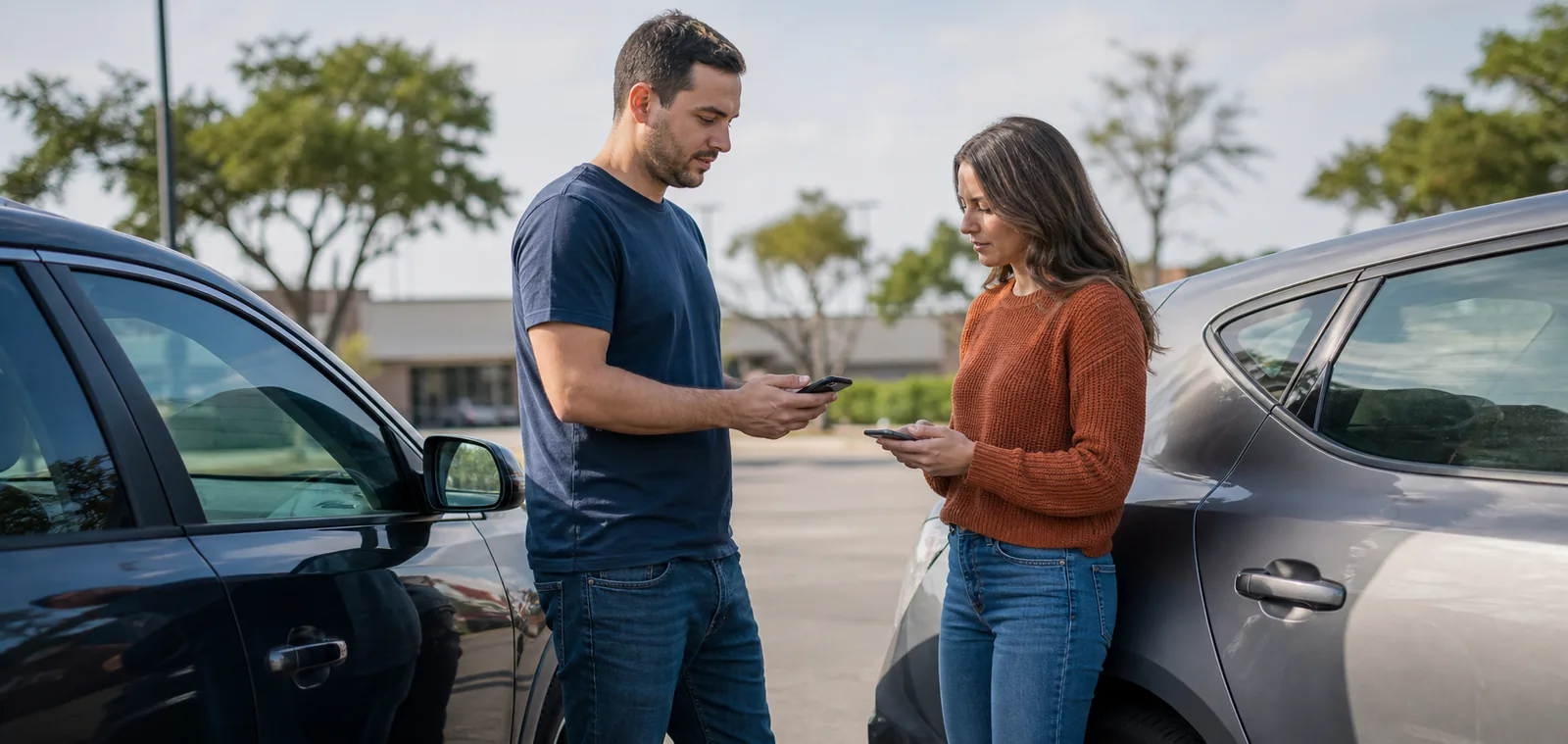
What to Do Immediately After a Car Accident in Texas
Short answer: check for injuries and call 911 if anyone is hurt, move vehicles out of traffic if it is safe, exchange information, photograph everything, get the police report number, and report the accident to your insurer promptly. Do not discuss fault at the scene.
The minutes after a collision are the worst possible time to figure out a process. Adrenaline compresses your judgment, and the decisions you make in the first ten minutes shape the claim for months afterward.
This is the order to work in, and the reasoning behind each step.
At the scene, in order
1. Check for injuries
People first. If anyone is hurt, or if you are unsure, call 911 and request medical assistance. Do not move an injured person unless they are in immediate danger from fire or traffic.
Adrenaline masks injury. Neck, back, and head injuries frequently do not present symptoms for hours or days. Declining medical evaluation at the scene and then seeking treatment two days later is common and it complicates the claim, because the gap becomes an argument about causation.
2. Get to safety
If the vehicles are drivable and the collision was minor, move them out of the travel lanes. Texas highways are dangerous places to stand, and secondary collisions at accident scenes are a real risk.
Turn on hazard lights. If you have flares or triangles and it is safe to place them, do so.
If a vehicle cannot be moved, get yourself and any passengers to a safe location away from traffic, not standing between vehicles.
3. Call the police
Call even for a minor collision. A police report documents the facts while they are fresh: positions, statements, conditions, and any citations issued.
Why it matters later: without a report, a claim frequently becomes one driver's account against another's. The other driver's version of events can change considerably between the roadside and the claim file.
A police report is also typically required for a hit-and-run claim, which is one of the most common uses of uninsured motorist coverage.
If law enforcement does not respond, note that, and document the scene thoroughly yourself.
4. Exchange information
Collect from every other driver:
- Full name and contact information
- Driver license number
- Insurance company name and policy number
- License plate number
- Vehicle make, model, and color
- The name of the vehicle's owner if it is not the driver
Also collect:
- Names and contact information for any passengers
- Names and contact information for any witnesses, which people forget and later wish they had
- The responding officer's name, badge number, and the report number
- The exact location, including cross streets or mile marker
Photograph the other driver's insurance card and license rather than transcribing them. It is faster and eliminates transcription errors.
5. Photograph everything
Your phone is the most valuable claim tool you have. Take far more photos than feel necessary.
- All vehicles, from multiple angles, showing damage clearly
- Wide shots showing the positions of the vehicles relative to each other and the roadway
- License plates
- Skid marks, debris fields, and broken glass
- Traffic controls: signals, stop signs, lane markings
- Road and weather conditions
- Any visible injuries
- The other driver's documents
- The overall scene from a distance, showing context
If vehicles need to be moved before police arrive, photograph the positions first. That set of photos is frequently the only evidence of how the collision actually occurred.
6. Do not discuss fault
Be civil and cooperative. Do not apologize, do not speculate about what happened, and do not accept or assign blame.
This is not about gamesmanship. Texas is an at-fault state and liability is determined after investigation, using evidence you may not have at the roadside. A driver who says "I'm so sorry, I didn't see you" may have had the right of way and simply been startled. That statement follows the claim.
State facts to police. Save analysis for the adjuster.
After you leave the scene
Seek medical evaluation
If you have any symptoms at all, get evaluated the same day or the next. Beyond your health, prompt treatment creates a medical record that connects the injury to the accident. Delayed treatment is the single most common reason injury claims get disputed.
Report to your insurer promptly
Report even if you believe the other driver was at fault, and even if you do not intend to file a claim on your own coverage.
Two reasons. Most policies contain a notice condition, and seriously delayed reporting can create a coverage problem. And you may need your own coverage later if the other driver turns out to be uninsured, underinsured, or disputes fault.
Have ready: the police report number, the other driver's information, your photographs, and a factual description of what happened.
Cooperate with the investigation
TDI notes that a company will nonrenew a policy when the insured does not cooperate with a claim investigation. Return adjuster calls. Provide requested documents. Unreturned calls are a preventable way to lose coverage entirely.
Start a file
Keep everything in one place: the police report, photos, medical records and bills, repair estimates, rental receipts, correspondence, and a log of every call including date, name, and what was said. Claims that take months are far easier to manage with contemporaneous notes.
Which coverage pays for what
Knowing this in advance removes a lot of confusion.
| Situation | Coverage |
|---|---|
| Damage you caused to others | Your liability |
| Your vehicle, you at fault | Your collision |
| Your vehicle, other driver at fault with insurance | Their liability, or your collision with reimbursement pursued |
| Your vehicle, other driver uninsured | Your uninsured motorist property damage, or collision |
| Your injuries, other driver uninsured or underinsured | Your UM/UIM bodily injury |
| Your medical costs regardless of fault | Your PIP or medical payments |
| Rental car while yours is repaired | Rental reimbursement |
| Towing from the scene | Towing coverage, or sometimes the liability claim |
If the other driver has no insurance, your uninsured motorist coverage is the only thing that pays for your injuries, lost wages, and pain and suffering. In Texas it must be rejected in writing, so check your declarations page.
The Texas specifics
Texas is an at-fault state. The party responsible for the accident, through their insurance, is responsible for the resulting damages. This differs from no-fault states where each driver's own policy handles their injuries first.
Proportionate responsibility applies. Fault can be apportioned between parties, and your recovery can be reduced by your share of responsibility. A driver found more than 50 percent at fault generally cannot recover from the other party. This is why avoiding statements about fault at the scene matters.
Minimum limits are low. TDI describes the Texas minimum as paying at most $30,000 for medical bills per person, $60,000 per accident, and $25,000 for property damage. If the at-fault driver carries the minimum and your damages exceed it, the shortfall falls to your own underinsured motorist coverage or to you.
Common mistakes
Agreeing to handle it privately. A driver who offers cash to avoid a claim may be uninsured, may be avoiding a suspension, or may simply change their mind. Damage frequently exceeds initial estimates, and injuries surface later. Once you have accepted cash and released them, you generally have no recourse.
Not calling police because the damage looks minor. Bumper covers hide structural damage, and injuries appear later.
Giving a recorded statement to the other driver's insurer without thinking. You are required to cooperate with your own insurer. You are not required to give a recorded statement to the other party's carrier, and doing so before you understand the extent of your injuries can hurt you.
Accepting a fast settlement offer. Early offers frequently arrive before the full extent of injury or vehicle damage is known. Once you sign a release, the claim is closed permanently.
Settling with the at-fault driver's insurer without notifying your own carrier. If you may have an underinsured motorist claim, settling without your carrier's consent can jeopardize it. This is a real trap and it is easy to fall into.
Not photographing the scene before moving vehicles.
Losing the witness. A neutral witness is the most valuable evidence in a disputed liability claim, and they leave within minutes.
If the other driver leaves
Hit-and-run is more common than most drivers expect.
- Call police immediately and get a report. This is typically a condition of the claim.
- Write down whatever you observed: plate fragments, vehicle color and type, direction of travel, any description of the driver.
- Look for cameras. Businesses, doorbell cameras, and traffic cameras may have captured it.
- Report to your insurer promptly, because uninsured motorist coverage is what responds.
- Note that some policies require physical contact between vehicles, which matters if you were run off the road without being struck.
Special situations
You were driving a company vehicle, or driving for work. Report to both your employer and your own insurer. A commercial auto policy may be primary, and personal auto may exclude business use entirely. Do not assume your personal policy responds.
You were driving for a delivery or rideshare app. Note whether the app was on, and which phase you were in: waiting for a request, en route to pick up, or carrying a passenger or order. Platform coverage differs sharply by phase, and your personal policy likely excludes the activity. Screenshot the app status before it changes.
You were driving someone else's car. Generally the vehicle owner's policy is primary and yours may sit excess. Report to both.
Someone else was driving your car. Your policy generally follows the vehicle for permissive users. Report it, and be prepared for questions about whether the driver had permission.
A commercial truck was involved. These claims are handled differently and often escalate quickly. Commercial carriers frequently dispatch investigators to the scene within hours. Document thoroughly and be cautious about giving a recorded statement to their carrier.
A government vehicle was involved. Claims against governmental entities in Texas involve different procedures and shorter notice deadlines than ordinary claims. Do not delay.
The accident happened in a parking lot. Police often will not respond to private property collisions. Document even more thoroughly than usual, since there will be no official report, and look for security cameras.
You suspect the other driver was impaired. Tell the responding officer. Do not confront the driver.
Injuries that show up later
This deserves its own section because it drives so many disputed claims.
Soft tissue injuries, concussions, and back injuries frequently do not present symptoms at the scene. Adrenaline suppresses pain, and inflammation develops over hours or days.
The practical consequences:
- Declining medical evaluation and then seeking care days later creates a gap that the other party's insurer will use to argue the injury came from something else.
- Telling the officer or the other driver "I'm fine" becomes part of the record. Saying "I don't know yet, I'm going to get checked out" is accurate and better.
- If symptoms appear later, seek care immediately and tell the provider it followed a motor vehicle accident, so it is documented in the chart.
- Keep every record: visits, imaging, therapy, prescriptions, and any time missed from work.
None of this is about building a case. It is about making sure an injury you actually sustained is not treated as unrelated because of a documentation gap you could have avoided.
Keep this where you can find it
Put a card in your glove box with: your insurance company and policy number, your agent's phone number, your carrier's claims line, and a short checklist of the steps above. Add an emergency contact.
Better still, take a photo of your insurance card and store it in your phone alongside a note with the same information. In the minutes after a collision, nobody remembers a process. They follow one if it is in front of them.
If you have been in an accident, use the carrier claims directory to report it promptly, then keep your declarations page and claim number available. Argo can help identify the relevant policy sections and carrier contact while the carrier investigates and decides coverage.
Related resources
How Argo can help
Not sure how this guide applies to you? A licensed Argo agent can review your situation in English or Spanish.
- Review your current policy or insurance requirement
- Explain coverage choices, limits, and deductibles
- Help you start a quote or plan the next step