
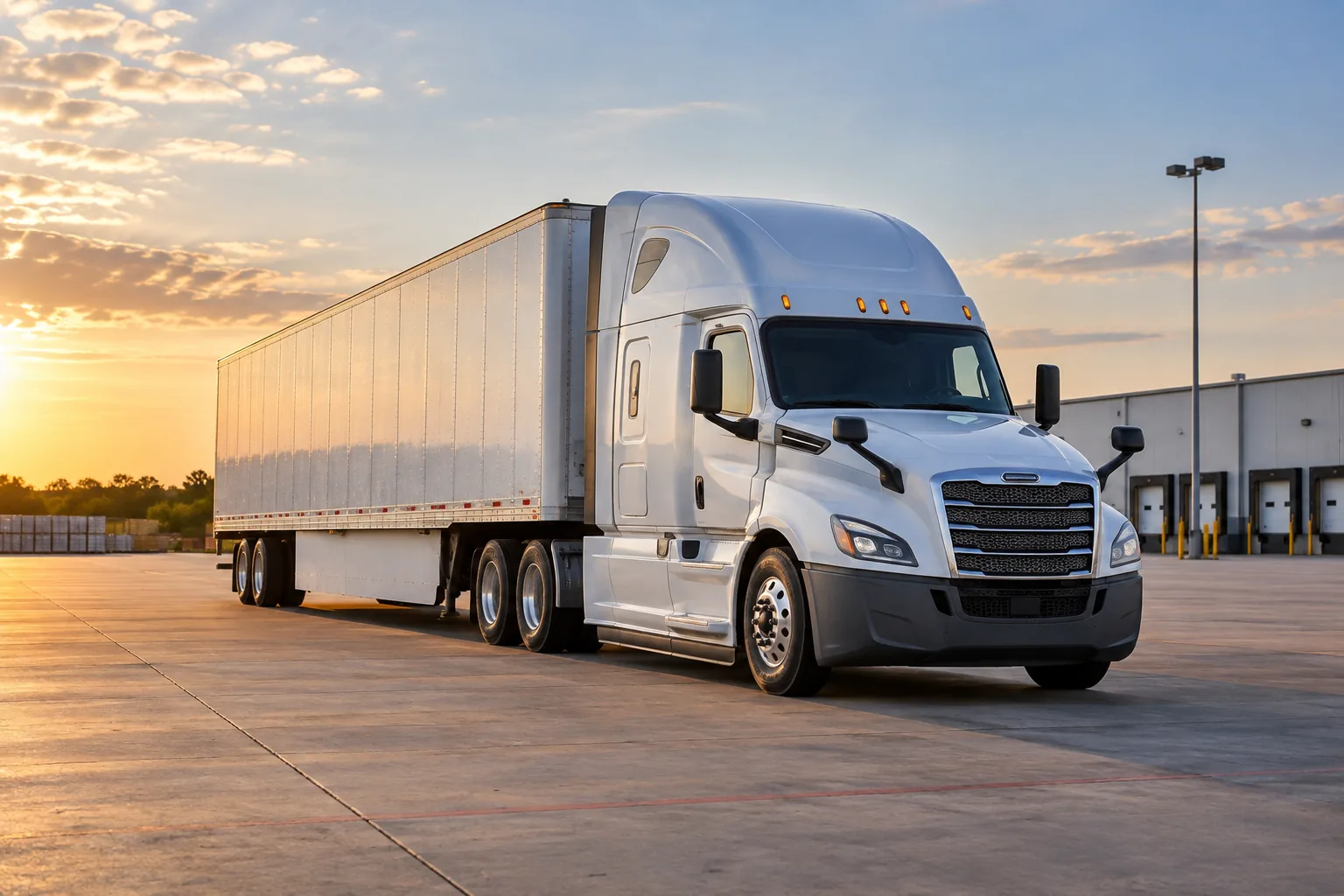
Semi Truck Insurance Texas: What It Covers
Short answer: semi truck insurance combines several coverages. For a for-hire interstate carrier hauling nonhazardous property in a vehicle rated at least 10,001 pounds, the federal public liability minimum is $750,000. TxDMV lists $500,000 for most private or for-hire intrastate carriers over 26,000 pounds. Cargo, physical damage, and other protections depend on the operation and on contracts, so the legal liability floor rarely answers the entire insurance question.
The gaps are practical. A trailer may be outside the physical damage schedule. Cargo limits or exclusions may not match the freight. A leased owner-operator may find that the motor carrier's liability policy and the separate non-trucking form treat a particular trip differently. Each question needs to be checked against the actual policies and lease.
This guide walks through what a semi truck policy in Texas actually contains, which parts are required by law, which are required by the people who give you freight, and where the gaps sit.
The legal floor and the contract requirement
Federal and Texas requirements address different operations. Confirm how each applies to your routes and authority.
Interstate. Under 49 CFR 387.9, a for-hire carrier moving nonhazardous property in interstate or foreign commerce with a gross vehicle weight rating of 10,001 pounds or more must maintain $750,000 of public liability. Certain hazardous materials raise the requirement to $1,000,000 or $5,000,000 depending on the material and how it is transported. Confirm the applicable category before choosing a limit.
Intrastate. For an operation subject to Texas intrastate motor carrier registration, Texas Transportation Code Section 643.101 directs TxDMV to set the amount. Its intrastate compliance guidance publishes the schedule: $500,000 for private or for-hire carriers over 26,000 pounds, $300,000 for household goods carriers under 26,000 pounds, $1,000,000 for oil and most listed hazardous materials, and $5,000,000 for the bulk hazmat categories. Buses run on their own schedule.
Registration with TxDMV is triggered by more than weight. It applies if you haul household goods for compensation regardless of size, operate a combination over 26,000 pounds, operate a vehicle designed for more than 15 passengers, run a commercial school bus, run a farm combination over 48,000 pounds, or transport placardable quantities of hazardous materials.
The legal floor is only one layer. Brokers and shippers may require a higher liability limit and cargo coverage by contract. A $1,000,000 combined single limit is a common request, but the actual requirement varies by customer and freight. Ask for the insurance exhibit before binding rather than assuming the regulatory minimum will satisfy a load agreement.
The useful question is which limits satisfy both the applicable filing and the contracts you plan to accept.
The coverages inside a real semi policy
Primary liability
This is the required piece. It responds to bodily injury and property damage you cause to others while operating under your authority. It is the coverage the filings certify and the coverage brokers verify on a certificate.
It does not insure your truck, your freight, or your driver's injuries. Review physical damage, cargo, and injury protection separately, whether they appear in one package or several policies.
Motor truck cargo
Cargo coverage addresses covered loss of or damage to freight, subject to the policy terms. FMCSA's filing chart lists a federal cargo filing requirement for certain household goods carriers; it lists no comparable cargo filing minimum for general freight. Broker and shipper contracts may still require cargo insurance and specify a limit. Compare that limit with the value and type of freight you accept.
Cargo forms may contain exclusions or conditions that matter for your freight:
- Refrigeration breakdown. Check whether equipment breakdown and resulting spoilage are covered, and whether the form requires maintenance or temperature records.
- Unattended vehicle theft. A form may restrict theft coverage when a truck is left outside a secured lot.
- Excluded commodities. Check whether the form excludes or limits any freight you haul, such as alcohol, tobacco, electronics, pharmaceuticals, or live animals.
- Loading and unloading. Depends entirely on form wording.
- Employee dishonesty and fictitious pickup. Ask how the form treats theft by deception or by an employee.
A cargo limit does not override an exclusion. A reefer carrier should check whether spoilage from equipment breakdown is covered and what records or maintenance conditions the endorsement requires.
Physical damage
Collision and comprehensive on your own equipment. Two settings decide what this is worth.
The first is stated value versus actual cash value. A stated amount is not necessarily a guaranteed claim payment. Review the valuation clause for the amount payable on a total loss; some forms pay the lesser of the stated amount and actual cash value.
The second is which equipment is covered. Check the tractor and trailer schedule and ask how the form handles non-owned trailers. Trailer interchange may be relevant when you take possession of another party's trailer under an interchange agreement, but the agreement and policy terms determine the protection.
Also compare the loan balance with the likely claim payment on a financed tractor. Ask whether a shortfall would remain after a total loss.
Non-trucking liability and bobtail
If you are a leased owner-operator, ask when the motor carrier's liability policy applies to your operation and when a separate non-trucking liability form may respond. Neither policy should be described as covering every trip solely by whether a trailer is attached or a load is on board.
An empty trip after delivery, travel to a repair shop, and travel toward a new load can have different purposes. Read the lease agreement and both policies together, and ask the agent to explain those trips in writing before relying on the coverage.
General liability
Auto liability responds to accidents arising out of the ownership, maintenance, or use of the vehicle. It does not respond to a premises slip at your yard, a forklift injury on a dock, or a claim arising from the shop side of your business. Many broker and shipper contracts require commercial general liability at $1,000,000 alongside auto, and a carrier who only bought auto fails that requirement.
Workers compensation or occupational accident
Texas does not require most private employers to carry workers compensation. That does not mean the exposure disappears. If you have employee drivers, injuries are your problem either way, and going without workers comp as a nonsubscriber carries its own legal consequences. Occupational accident coverage is a common substitute for owner-operators, but it is not workers comp and does not satisfy a contract that specifically says workers compensation.
Trailer interchange, reefer breakdown, rental reimbursement
These are operation-specific choices. Ask about trailer interchange if you pull non-owned trailers, reefer breakdown if you haul temperature-controlled freight, and rental reimbursement or downtime protection if a disabled truck would interrupt revenue. Availability and triggers depend on the form.
Filings, and what actually activates authority
Buying a policy alone does not complete an operating authority application that requires an insurance filing.
BMC-91 or BMC-91X is the federal proof of public liability filed by an authorized insurer with FMCSA for applicable authority. FMCSA lists both forms. The filing is one requirement for authority; check FMCSA's status before operating.
Form E is the Texas liability filing submitted by an insurer to TxDMV for intrastate authority. TxDMV says the insurer files it, and the motor carrier is responsible for confirming that the insurance record remains active.
MCS-90 is an endorsement to a motor carrier's liability policy, not the proof-of-insurance filing. It supports the federal public liability requirement in specified circumstances; it is not a substitute for cargo, physical damage, or coverage for the carrier's own loss. The endorsement can require the motor carrier to reimburse the insurer for payments that would not otherwise be covered by the policy. Read the FMCSA form and instructions with your agent.
BMC-34 or BMC-83 is the federal cargo proof filing for carriers required to provide one. BMC-32 is a separate household goods cargo endorsement, not the filing form. Texas household goods carriers may also need Forms H and I filed with TxDMV.
If required insurance is canceled and no replacement filing is in effect, an authority can face suspension or revocation. Arrange any replacement filing before the old coverage ends and verify the status with FMCSA or TxDMV.
What underwriters look at on a semi
Pricing on a tractor-trailer is not a formula you can run yourself, but the inputs are not a secret either.
- Authority age. A new authority has limited operating and loss history. Some insurers may offer fewer options or different terms until they can evaluate a longer record; there is no guaranteed 12- or 24-month price reduction.
- Driver MVRs and experience. Insurers may consider verifiable CDL experience and motor vehicle records. A major violation can affect eligibility or terms.
- Radius of operation. Local and long-haul work present different exposures. State the intended radius accurately and ask how the policy treats trips outside it.
- Commodity hauled. Dry van, reefer, flatbed, tanker, auto hauling, and hazmat present different exposures to review.
- Equipment. Year, model, value, and whether the tractor carries cameras or telematics.
- Loss history. Ask which years of loss runs a market needs and how it weighs claim frequency and severity.
- Safety history. FMCSA's Compliance, Safety, Accountability program provides inspection and crash information that an insurer may consider alongside driver and loss records.
- Filing history. A market may ask about prior lapses, cancellations, and authority status.
Driver screening, maintenance records, accurate operations information, and uninterrupted required filings can strengthen an underwriting submission. The effect on eligibility or price depends on the insurer; ask what documentation a market will actually use.
The full breakdown of trucking rate drivers goes deeper on each.
What you cannot get from a website
The Texas Department of Insurance explains that it does not set the premiums insurers charge. Rate filing rules depend on the insurer and coverage, so that general guidance does not create a state price list for a particular truck.
Two carriers can quote the same operation differently because their underwriting rules, available forms, and appetite differ. A national average cannot tell you which quote will fit your drivers, equipment, radius, and commodities.
The certificate side
Once you have coverage, the document a broker or shipper asks for is a certificate of insurance. In Texas, certificates fall under Insurance Code Chapter 1811, and the rules are stricter than most people realize.
A certificate cannot grant coverage the policy does not provide. If a shipper requires additional insured status or a waiver of subrogation, check the relevant policy wording or endorsement before requesting the certificate. Per TDI's guidance, a certificate may describe a blanket additional insured endorsement but cannot name the holder as an additional insured based only on that blanket form. It cannot restate another contract's insurance requirements or use a supplemental questionnaire as a substitute for an approved certificate.
Practically: read the broker packet before binding, not after. Adding endorsements under a load deadline is how carriers end up buying the wrong policy in a hurry. The certificate timing guide covers what can realistically be turned same day.
A pre-bind checklist
- Are you interstate, intrastate, or both, and which limit schedule actually governs you?
- What liability limit do your target brokers and shippers require, in writing?
- What cargo limit does the contract require, and does the form exclude the commodity you actually haul?
- If you run reefer, is refrigeration breakdown endorsed, and what does it require of you operationally?
- Is every tractor and trailer you own on the physical damage schedule?
- Do you pull trailers you do not own, and is trailer interchange in place?
- Is stated value realistic, and is there a loan balance gap on any financed unit?
- If you are leased on, does your non-trucking liability form match the dispatch language in your lease?
- Do you have general liability, or only auto liability, given what the contracts demand?
- Employee drivers: workers compensation, or a documented nonsubscriber decision?
- Are the applicable BMC-91 or BMC-91X and Form E filings active where required?
- Do you understand that the MCS-90 protects the public and not your balance sheet?
Three operations, three different programs
A single owner-operator leased to a carrier, running dry van regional out of Houston. The lease and carrier's policies determine which liability and cargo exposures the motor carrier insures. The operator should compare those terms with any non-trucking liability, physical damage, and occupational accident options. Do not assume the motor carrier's policy follows the truck on every trip.
A two-truck authority running reefer to the Valley and back. The owner should compare the required liability and cargo limits with broker contracts, confirm whether reefer breakdown can be covered, list covered equipment, and decide how to address driver injuries. If the business has employees and does not carry Texas workers compensation, it must review nonsubscriber duties as well as any contract requirement.
A flatbed operation hauling equipment for a Texas contractor, intrastate only. A carrier subject to TxDMV's over-26,000-pound category faces a $500,000 liability minimum. The contractor's written requirements may call for a higher limit, cargo coverage, or additional insured status. Confirm those terms and the cargo form before taking the job.
These examples show why the applicable legal minimum, customer contract, and actual policy must be checked separately.
Frequently asked questions
How much liability insurance does a semi truck need in Texas?
The applicable minimum depends on interstate or intrastate operation, vehicle weight, and cargo. FMCSA lists $750,000 for the common for-hire interstate nonhazardous freight category at 10,001 pounds or more; TxDMV lists $500,000 for most intrastate carriers over 26,000 pounds. Hazardous material categories and customer contracts may require more.
Does a semi truck policy automatically include cargo coverage?
No. Ask for the cargo form and confirm its limit, covered commodities, exclusions, and any temperature-control conditions. A liability filing does not prove that a general freight load is insured for cargo loss.
What is an MCS-90 endorsement and does it protect my truck?
It is part of the federal public liability framework. It does not insure physical damage to your tractor or cargo, and a payment made under the endorsement can create a reimbursement obligation for the carrier.
What is the difference between BMC-91X and Form E?
BMC-91 or BMC-91X is federal proof of liability insurance for applicable FMCSA authority. Form E is Texas proof of liability insurance for applicable intrastate authority. The insurer files them with different agencies.
Is bobtail coverage the same as non-trucking liability?
The names are sometimes used loosely. Check the policy's definition of covered use and compare it with the lease and the motor carrier's policy, especially for empty trips.
Does semi truck physical damage cover the trailer I pull but do not own?
Do not assume it does. Check the equipment schedule and whether trailer interchange or another non-owned trailer provision applies to the trailer and agreement.
Where Argo fits
Argo Insurance can review commercial trucking options based on authority age, radius, commodity, drivers, equipment, and loss history. Available terms vary by insurer and submission.
Start with a trucking quote. Be ready to provide your authority details, equipment and driver information, radius, commodities, loss runs, and any broker or shipper insurance exhibit through the agency's appropriate intake process. Argo can compare available terms and identify questions to resolve before binding.
Coverage descriptions here are general. Limits, exclusions, endorsements, and eligibility vary by carrier, and the policy issued controls.
Related resources
How Argo can help
Not sure how this guide applies to you? A licensed Argo agent can review your situation in English or Spanish.
- Review your current policy or insurance requirement
- Explain coverage choices, limits, and deductibles
- Help you start a quote or plan the next step