
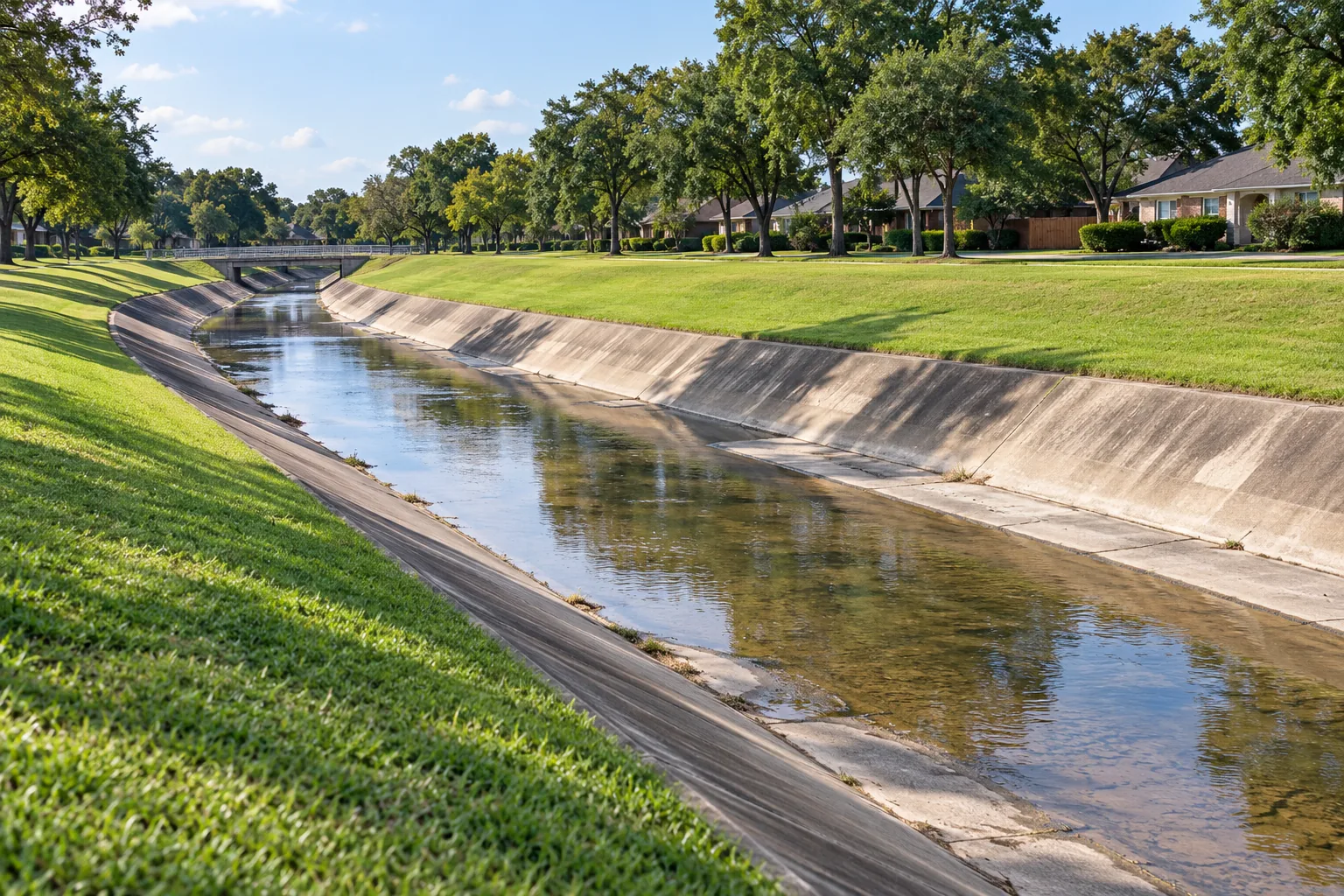
Flood Insurance Cost in Houston
Short answer: since FEMA moved to Risk Rating 2.0, your Houston flood premium is built from your specific building rather than from the flood zone on a map. The factors are flood frequency, the kinds of flooding you face, how close you are to water, your first floor height, and what it costs to rebuild. NFIP transition rules limit many annual increases, but the often-cited 18 percent figure does not cover every policy or every component of a bill. Private policies have different terms.
The more important number in this post is not a premium. In Harris County, two independent sources find that most flood losses and most flood-prone homes sit outside the mapped high-risk zone. If you have concluded you do not need flood insurance because you are not in a flood zone, that is the paragraph to read.
Your zone is not your risk, and Harris County proves it
The Harris County Flood Control District states it under a heading of its own: 68 percent of Harvey flood claims were located outside of the 100-year floodplain, with the figure given as roughly two thirds of structural damages reported outside the mapped 100-year floodplain. HCFCD also says more generally that many flood loss claims in Harris County are located outside the mapped 100-year floodplain.
That figure is specific to Hurricane Harvey, which was an extraordinary event. So here is a second measure from a different source using a different method. Rice University researchers published in August 2025 that 56 percent of flood-prone homes in Harris County sit outside FEMA flood zones, that about 603,000 residents, roughly 12 percent, live in these overlooked buildings, and that overlooked areas see higher average rainfall flood depths, 15 centimeters against 7 centimeters inside mapped zones. The work was led by Yilei Yu at Rice's Center for Coastal Futures and Adaptive Resilience with colleagues at Arizona State University, published in Population and Environment.
Those measure different things. One counts claims after a storm, the other counts flood-prone homes and residents. They point the same direction.
HCFCD adds the context around it: homeowners insurance does not include flood coverage, floods are Harris County's number one natural hazard, more homes flood annually in Harris County than are destroyed by fire, a major flood occurs somewhere in the county about every two years, and the damage from just one inch of water can cost more than $20,000. TDI's own column puts the one-inch figure at about $25,000. Two official sources, two numbers, both worth knowing and neither worth averaging.
And the eligibility point that closes the argument: HCFCD states that if you live in Harris County, you are eligible to purchase a flood insurance policy through the NFIP. Congress mandates flood insurance on mortgaged properties in the 100-year floodplain through federally regulated or insured lenders. Owners without mortgages and owners outside the floodplain are not required to buy it. Not required is not the same as not exposed.
How Risk Rating 2.0 actually sets the price
FEMA's Understanding Risk Rating 2.0 fact sheet, dated July 2025, says the methodology assesses many factors for individual properties, including:
- Frequency of flooding
- Multiple flood types, meaning river overflow, storm surge, coastal erosion, and heavy rainfall
- Proximity to flood sources
- Building characteristics, such as first floor height and the cost to rebuild
The word including signals the list is not exhaustive. On the shift away from maps, FEMA says the prior method primarily considered flood zones and elevations, and that the new rating is specific to the building rather than a blanket rate based on a flood map.
Be precise about what that does and does not mean. FEMA does not say flood zone is irrelevant to price. It says rating is building-specific rather than a blanket map-based rate, and separately that flood map data informs the catastrophe models used to develop rates. Those are different claims, and the second one is the accurate version.
FEMA's agent guidance on what goes into a rate adds distance to a water source, elevation, the cost to rebuild, home value, which determines how premiums are spread across policyholders, the property's unique flood risk, different deductibles for building and contents coverage, and first floor height, which FEMA determines with its own tools.
The same guidance names the mitigation actions that lower premiums: elevating machinery and equipment, adding flood openings, and elevating the building. For a Houston homeowner, elevating the HVAC condenser and the electrical equipment is the version of that advice most likely to be practical.
One correction worth making, because it still circulates. The Preferred Risk Policy no longer exists. FEMA stated in its Risk Rating 2.0 FAQ that it will no longer offer the Preferred Risk Policy product, and that existing policies formerly eligible for grandfathering will transition to their new full-risk premium. So there is no cheap flat-rate product for low-risk-zone properties any more, and grandfathering is gone. A Houston buyer outside the mapped high-risk zone is rated on their building.
Coverage limits
The NFIP maximums, per FEMA:
| Coverage | Maximum |
|---|---|
| Residential building | $250,000 |
| Residential contents | $100,000 |
| Non-residential building | $500,000 |
| Non-residential contents | $500,000 |
TDI confirms the residential figures in Texas terms, noting a flood policy will cover your home up to $250,000, with personal belongings requiring separate contents coverage up to $100,000, and that renters can get up to $100,000 for belongings. HCFCD confirms the same two numbers.
If your Houston house would cost more than $250,000 to rebuild, and at the current Texas average coverage amount many would, the NFIP limit is not the end of the conversation. The Office of Public Insurance Counsel gives the example directly: if a home needs $350,000 of flood coverage against the NFIP's $250,000 limit, you may be able to buy excess coverage for the $100,000 difference elsewhere.
The 30-day wait, and the four exceptions
This is the single most consequential piece of flood insurance mechanics, because it removes the option of buying when the forecast turns.
FEMA states coverage starts 30 days after purchase, with four exceptions:
- No wait if you buy flood insurance while making, increasing, extending, or renewing a mortgage
- No wait if you change your flood insurance coverage while renewing your policy
- A one-day wait if your property is in a newly designated high-risk flood zone and you buy a policy within 12 months of the update
- A one-day wait if a flood is caused or worsened by a wildfire on federal land and you buy a policy within 60 days of the wildfire containment date
TDI says the same thing in plainer language: a policy usually starts 30 days after buying it, so do not wait until a storm is on the way. HCFCD and OPIC both repeat the 30-day point.
The practical consequence for Houston is seasonal. If you are reading this in May, you have time. If you are reading it with something in the Gulf, you do not, and the honest answer is to buy anyway for next time.
Understand NFIP transition increases
FEMA's Risk Rating 2.0 guidance says most policyholders moving toward full-risk pricing have annual increases limited to 18 percent. This does not promise every total bill will rise no more than 18 percent. Changes in limits, deductibles, fees, surcharges, rating corrections, and statutory exceptions can affect the amount due.
42 U.S.C. Section 4015 sets different rules for individual properties and specified subsidized categories, including 25 percent transitions. A rental or second-home label alone does not establish the calculation for an individual renewal.
Ask for the full-risk premium, transition treatment, reason for the increase, and comparison with unchanged coverage. These NFIP rules do not cap private flood renewal prices. Check continuity and future pricing before cancelling.
Community discounts and the address
FEMA's Community Rating System can reduce eligible NFIP premiums in participating communities. The class can change, and the community is not necessarily the postal city.
Have the agent confirm the current community code, applicable discount, and whether it is already included in the quote. Do not budget from Houston's 2021 presentation or assume an identical discount for unincorporated Harris County.
A CRS credit is separate from building-specific mitigation. Keep occupancy, foundation, and first-floor information accurate; corrections can change the quote. Ask which records would help establish those details before accepting a renewal as the only available price.
Where to buy it, and the Texas wrinkle
TDI's flood insurance page, last updated May 22, 2024, is direct: if it can rain, it can flood, and your home insurance policy does not cover flood damage. It directs you to talk to your home insurance agent about getting a policy from the National Flood Insurance Program, and if your agent does not sell flood insurance, to call 800-427-4661 or visit FloodSmart.gov to find one.
An older statewide average on a general guidance page is not a current Houston quote. Compare proposals for the address with the same limits, deductibles, occupancy, and effective date.
On private flood, the Texas guidance comes from OPIC rather than TDI. OPIC's shopping guide, last modified March 1, 2023, notes that most residential flood policies are FEMA NFIP policies with limited options, but that more companies are starting to offer flood coverage through endorsements or separate policies, and lists four possible policy types including a policy through the surplus lines market. OPIC's advice is to ask whether a policy is NFIP-equivalent or better, and if better, how, noting some companies only offer NFIP policies. It describes coverage tiers ranging from limited, such as $10,000 of structure and contents, through equal to NFIP, to above NFIP with additional living expense or higher limits.
Use OPIC's comparison questions to check a current proposal, not its publication date as evidence that a particular private option is available today.
And one thing Texas does not have. There is no state flood insurance pool. Texas's two residual property mechanisms are TWIA, which covers wind and hail losses only, and the Texas FAIR Plan, which covers named perils and not flood. Flood coverage in Texas comes from the NFIP or from the private and surplus lines market, full stop.
Look up your own address first
FEMA's Flood Map Service Center is the official public source for flood hazard information produced in support of the National Flood Insurance Program. You can look up a property by address, place, or coordinates.
Do it even if you are confident you are not in a flood zone, and then read the Harris County figures above again. The map tells you what the lender will require. It does not tell you whether your street holds water in a six-inch rain. Our Houston flood zone map page covers reading the result, and the Houston flood insurance page for homebuyers covers the closing timeline.
Checklist
- Have you looked up your address on FEMA's Flood Map Service Center?
- Do you understand that being outside the mapped high-risk zone is not the same as being outside the risk, given HCFCD's 68 percent Harvey figure and Rice's 56 percent finding?
- Have you accounted for the 30-day waiting period, and do you know which of the four exceptions might apply to you?
- Does $250,000 of building coverage actually rebuild your house, and if not, have you priced excess flood?
- Have you bought contents coverage, which is separate and capped at $100,000?
- Are your building and contents deductibles set where you want them, since FEMA allows different ones?
- If your premium is rising faster than 18 percent, is your property in one of the Section 4015(e)(4) categories required to rise 25 percent?
- Have you asked what community discount applies to your address, and whether your property is inside Houston city limits or in unincorporated Harris County?
- Have you priced the mitigation FEMA names, meaning elevating machinery and equipment, adding flood openings, or elevating the building?
- Have you compared an NFIP quote against a private or surplus lines quote on coverage terms, not just price?
Frequently asked questions
What determines Houston flood pricing?
Risk Rating 2.0 evaluates the building's flood exposure and characteristics, including proximity to water, elevation-related details, and rebuild cost. Private insurers use their own methods.
Can a lower-risk-zone home still flood?
Yes. A mapped zone and a lender requirement do not describe every rainfall or drainage risk. Consider property history and local conditions as well as the map.
How long is the NFIP waiting period?
Usually 30 days. Exceptions include qualifying mortgage transactions, renewal changes, map revisions, and post-wildfire situations. Confirm the applicable effective date.
What NFIP limits apply to a typical house?
One-to-four-family residential buildings can have up to $250,000 of building coverage and $100,000 of contents coverage, purchased separately with separate deductibles. Other building types have different rules.
Is every flood renewal capped at 18 percent?
No. NFIP transition caps have exceptions, and coverage changes, fees, or corrections can affect the bill. Some categories use 25 percent transitions; private premiums follow different terms.
Are lower-cost options still possible?
Yes. The old Preferred Risk Policy is no longer offered, but lower-risk buildings can have lower premiums and private quotes can differ. Match coverage before comparing price.
Where Argo fits
Bring your address, lender requirements, and current coverage so Argo can compare available flood terms and effective dates. Our Houston flood-map guidance explains why the mapped zone is only part of the decision.
Request a flood insurance quote to compare your options.
This is general information about insurance and is not a quote. NFIP rating, caps, and discounts are set by FEMA and federal statute and can change, the figures cited carry the dates of their sources, no premium figure here applies to any specific property, and the policy issued controls.
Related resources
How Argo can help
Not sure how this guide applies to you? A licensed Argo agent can review your situation in English or Spanish.
- Review your current policy or insurance requirement
- Explain coverage choices, limits, and deductibles
- Help you start a quote or plan the next step