
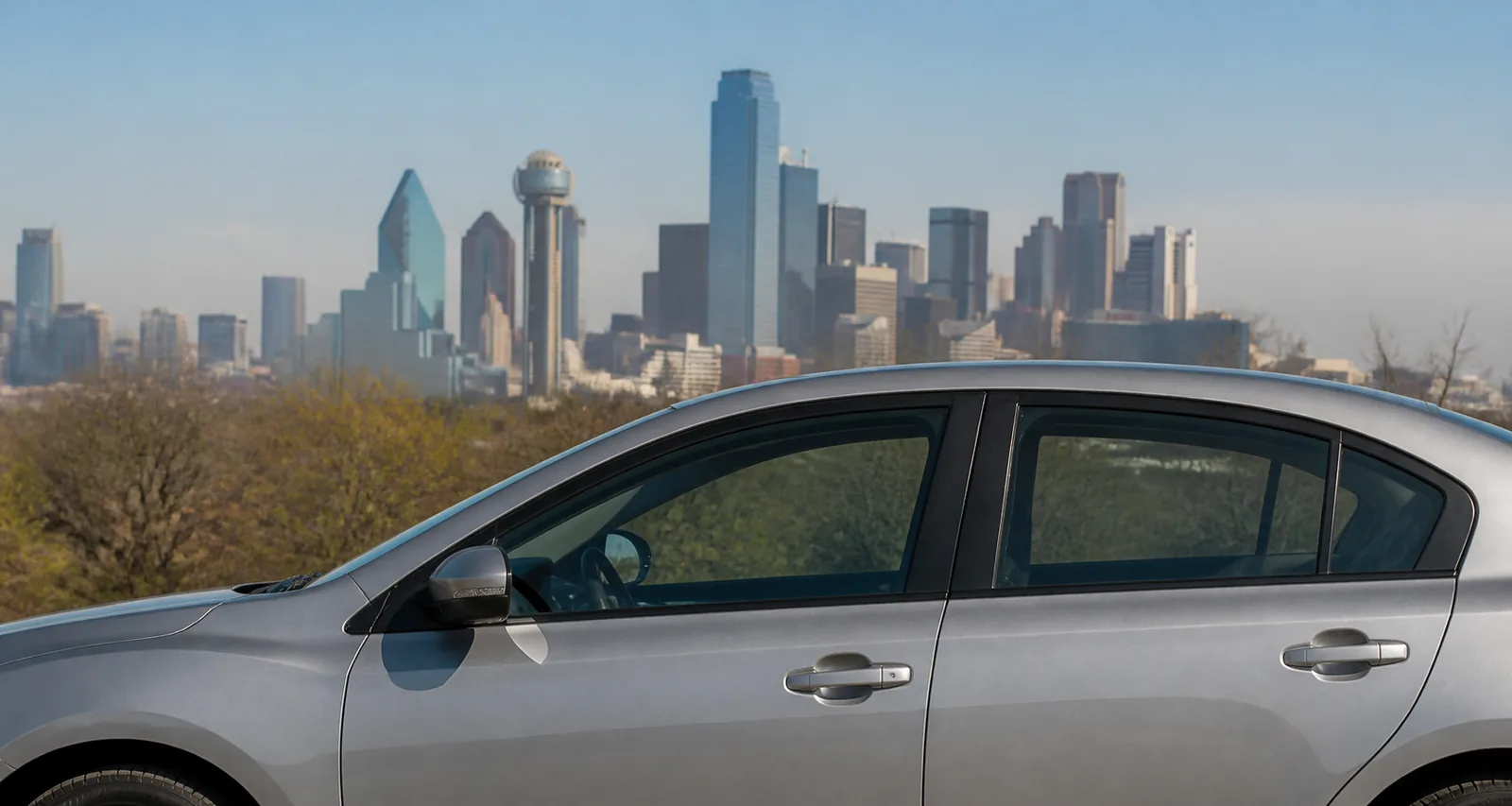
Cheap Car Insurance in Dallas: What Lowers It
Short answer: what lowers a Dallas auto premium is the same set of levers that works anywhere in Texas, applied to a market with unusually heavy hail exposure and wide ZIP-code variation. Shop multiple carriers first, because each one weighs Dallas-Fort Worth risk differently. Then claim every discount, then set deductibles you could actually pay after a storm. Dallas drivers frequently assume their rates are high because of traffic. Traffic is part of it. The larger driver in DFW is weather, because North Texas sits in one of the most active hail corridors in the country and comprehensive losses there are frequent rather than occasional.
This guide covers what actually moves a Dallas rate and in what order to work on it.
Why Dallas rates look the way they do
Hail. DFW takes severe hail regularly, and vehicle hail claims run through comprehensive coverage. A metro-wide storm can produce tens of thousands of vehicle claims in an afternoon. Carriers price that exposure into the territory, and they manage how much of it they are willing to hold, which is why appetite in DFW shifts year to year.
Traffic density and commute distance. The metroplex spreads across a wide area with long commutes on high-speed corridors. More miles at highway speed means more exposure and more severe accidents when they happen.
Repair costs. Modern vehicles carry sensors and cameras in bumpers, mirrors, and windshields. A minor collision now involves parts and calibration that did not exist a decade ago, and DFW labor rates reflect a large metro market.
Theft. Certain vehicle models have seen sharp theft increases, and catalytic converter theft has been a persistent comprehensive driver across Texas metros.
Uninsured drivers. Texas has a meaningful uninsured population, and those accidents are absorbed through uninsured motorist coverage on everyone else's policies.
None of these are within your control. What follows is.
ZIP code matters more than city
This is the single most misunderstood factor among Dallas drivers.
Carriers do not rate "Dallas." They rate the specific location where the vehicle is garaged overnight, and the differences across the metroplex are substantial. Rating territories reflect accident frequency, theft rates, vandalism, repair costs, litigation patterns, and weather exposure at a granular level.
Two practical consequences:
Moving a few miles can change your premium, and moving within the metro is a reason to re-quote rather than assume the rate carries over.
A carrier competitive in one part of DFW may be expensive in another. Companies manage geographic concentration, and one already heavily exposed in a hail-prone county may price new business there high specifically to slow growth, regardless of how clean your record is.
Use the address where the car actually sits overnight, not a work address or a mailing address. Misstating garaging is misrepresentation and it surfaces at claim time.
Lever 1: shop multiple carriers
This is first because it is the largest lever and the only one that does not cost you coverage.
TDI is direct that the state does not set insurance premiums. Each company files its own rates and weighs factors differently, which is why the same Dallas driver can get quotes that differ substantially on the same afternoon.
Do it properly:
- Quote identical coverage everywhere. Same limits, same deductibles, same uninsured motorist election. Different coverage is not a comparison.
- Use TDI's HelpInsure.com for official sample estimates and to check company complaint indexes and financial ratings.
- Use an independent agent to run one set of details across many carriers at once. TDI's shopping guidance notes you can do exactly that.
- Never cancel before the new policy is in force. TDI's instruction is to never cancel until you have the new policy or written proof of coverage. A gap becomes its own rating factor for years.
Lever 2: get the comprehensive deductible right
This deserves its own section in DFW specifically, because it is where the hail exposure meets your wallet.
Hail damage to a vehicle runs through comprehensive coverage, not collision and not liability. If you carry liability only, hail damage to your car is not covered at all.
Your comprehensive deductible determines whether the coverage is actually useful. A $2,000 comprehensive deductible on $2,400 of hail damage produces a $400 payment. In a market where hail claims are frequent rather than remote, a very high comprehensive deductible can quietly cancel the coverage you are paying for.
The right approach in DFW:
- Consider a lower comprehensive deductible than you might carry elsewhere, because the claim is likely.
- Keep the collision deductible wherever your cash reserves allow, since it is a separate setting.
- Ask whether glass is handled separately, because some Texas policies treat windshield claims differently and modern windshields with embedded sensors are expensive.
- If you park in a garage rather than outside, say so, because it affects both the risk and sometimes the rate.
Lever 3: claim every discount
Discounts are not applied automatically. Ask by name.
- Multi-policy, bundling auto with home or renters. Usually the largest available.
- Multi-vehicle.
- Safe driver and claim-free.
- Defensive driving, for an approved course.
- Good student, and student away at school if a young driver attends school beyond a stated distance without a car.
- Low mileage, which matters for remote workers and is frequently unclaimed in a metro where long commutes are assumed.
- Pay in full, avoiding installment fees.
- Paperless and autopay.
- Anti-theft and safety equipment.
- Affinity discounts through an employer, alumni association, or professional group.
Two cautions. A discount on a higher base rate is not a bargain, so compare final premiums. And discounts expire silently, which is one reason renewal premiums drift upward with no apparent cause.
Lever 4: decide liability-only versus full coverage deliberately
"Full coverage" is not a policy type. It is informal shorthand for liability plus collision plus comprehensive, and it says nothing about your limits.
Liability only is cheaper on premium. It is not automatically better value, and in DFW it has a specific consequence: no hail coverage on your vehicle.
Run the actual numbers rather than a rule of thumb. Take the vehicle's current market value, subtract your deductible, and compare that to what you pay annually for collision and comprehensive. If a total loss would pay $2,600 and you are paying $1,000 a year for the privilege, the math deserves examination.
Two conditions that override the math. If the vehicle is financed or leased, the lender requires physical damage coverage and this is not your decision. And if losing the car would mean you could not get to work, keeping coverage may be worth more than the arithmetic suggests.
Never drop liability. Texas minimum liability pays at most $30,000 for medical bills per person, $60,000 per accident, and $25,000 for property damage. A serious accident on a DFW highway exhausts that quickly, and the remainder becomes a personal judgment collectible against assets and future wages.
Lever 5: the factors that improve over time
Driving record. Tickets and at-fault accidents age off. Ask your agent when yours drops, and re-shop then, because carriers do not volunteer the reduction.
Credit-based insurance score. Texas insurers may use one as a rating factor. It is not the same as a lending score, and it improves with ordinary credit habits.
Continuous coverage. Prior coverage without gaps is itself a rating factor, and it compounds over time.
Age and experience, with a meaningful step for most carriers around 25.
What does not work
Buying minimum liability to make the number small. This does not reduce your risk. It moves it onto your own assets.
Dropping uninsured and underinsured motorist coverage. It protects you, not the other driver, and it must be rejected in writing in Texas, which means many drivers declined it without registering that they had.
Understating mileage or garaging address. A cheaper premium built on inaccurate information is a claim denial waiting to happen.
Letting the policy lapse while shopping. The most expensive month you will ever save.
Hiding business use. Delivery, rideshare, and hauling tools generally fall outside a personal policy.
A DFW-specific checklist
- Confirm your garaging ZIP is correct and current
- Find your comprehensive deductible and ask whether it makes sense given local hail frequency
- Confirm whether you park in a garage, carport, or outside, and tell your carrier
- Check whether uninsured and underinsured motorist is present or was rejected
- Verify your liability limits are meaningfully above the state minimum
- Ask for a full discount review by name
- Confirm your actual annual mileage rather than an old estimate
- Photograph your vehicle annually so you have dated pre-storm condition evidence
- Get comparable quotes from several carriers on identical coverage
- Bind the new policy before cancelling the old one
After a DFW hailstorm
Because this is the claim most likely to happen here.
Photograph the vehicle in good light from multiple angles before moving or repairing it, and note the storm date.
Report promptly. Adjuster availability tightens fast after a metro-wide event, and early reporters get inspected sooner.
Expect repair backlogs. Paintless dent repair shops book out for weeks after a major storm. This is when rental reimbursement earns its cost, and when drivers without it discover the gap.
Be careful with storm chasers. Operations appear in affected neighborhoods within days. Confirm any shop with your adjuster, get the scope in writing, and be wary of anyone offering to absorb your deductible.
Understand total loss risk. Hail damages every horizontal panel at once, so the estimate on an older vehicle can exceed its value. If that happens you receive actual cash value minus your deductible, and if you owe more, only gap coverage closes the difference.
Common Dallas driver situations
Long commute from a suburb into the core. High annual mileage on high-speed corridors. Report your actual mileage rather than an old estimate, and ask whether any carrier in the agency's book weights commute distance more favorably. Telematics can help if your driving is consistent and daytime.
Remote or hybrid worker. One of the most commonly unclaimed savings in DFW. Many drivers are still rated on a commute they stopped making years ago. Low-mileage discounts and usage-based programs both favor this profile.
Apartment dweller with no garage. Your vehicle sits outside through every hail season. This argues for a lower comprehensive deductible, not a higher one, and it is worth adding a renters policy since it is inexpensive and frequently unlocks a multi-line auto discount that offsets much of its own cost.
Household with a teen driver. The largest single household increase most families experience. Keep the teen on the household policy where eligible, submit good student documentation, and choose the vehicle with insurance cost in mind.
Driver with a recent violation. Re-shop specifically for it. Carriers surcharge violations very differently, and the company that was cheapest with a clean record frequently is not afterward.
Recently moved within the metro. Re-quote. The garaging territory changed, and the change can go either direction.
Driving for a delivery or rideshare app. This generally falls outside a standard personal policy. It needs either a specific endorsement or a commercial policy, and it is a coverage gap rather than a pricing question.
Dallas and Houston are different markets
Worth stating because drivers moving between the two Texas metros often assume rates transfer.
Hail is the dominant property and comprehensive driver in DFW. North Texas sits in an active hail corridor, and vehicle hail claims there are frequent.
Flood and hurricane exposure shape the Houston market in a way they do not shape Dallas. Houston-area drivers deal with vehicle flood losses, which also run through comprehensive, and Houston-area homeowners deal with windstorm and flood considerations that DFW largely does not.
Carrier appetite differs between the two. A company aggressive in Houston may be restrictive in DFW and the reverse, because they are managing different catastrophe concentrations.
If you are relocating between them, treat it as a full re-quote rather than an address change on an existing policy.
Where Argo fits
Argo Insurance is independent and writes across multiple carriers, which matters in DFW specifically because hail appetite varies so much between companies and shifts year to year. The carrier that was competitive in your ZIP two years ago frequently is not today.
To compare Texas auto options, send your current declarations page, garaging address, and renewal date. We can check available carriers for that location and show whether a lower premium also changes limits, deductibles, or coverage.
This article describes how Texas auto pricing generally works and cites TDI consumer guidance as of the review date. It does not quote or predict any individual rate. Your premium is determined by the carrier's filed rates and your own underwriting details.
Related resources
How Argo can help
Not sure how this guide applies to you? A licensed Argo agent can review your situation in English or Spanish.
- Review your current policy or insurance requirement
- Explain coverage choices, limits, and deductibles
- Help you start a quote or plan the next step