
Does Homeowners Insurance Cover Frozen Pipes in Texas?
Short answer: A Texas homeowners policy may cover sudden water damage from a frozen pipe that bursts. Coverage for the damaged flooring, the pipe repair and the work needed to reach the pipe are separate questions. The Texas Department of Insurance (TDI) warns that coverage can depend on precautions such as keeping the heat on. If water is already leaking, shut it off when safe and call your insurer promptly.
What a Texas home policy actually promises on water
TDI's home insurance guide puts it in two columns. Most policies cover damage from a sudden and accidental release of water. Most policies do not cover damage from a continuous water leak.
TDI's water damage and mold page gives the examples it has in mind: a burst pipe, a toilet overflow, or a broken washer hose. A pipe that splits during a freeze and floods a hallway when it thaws is close to the textbook case of sudden and accidental.
So the starting position is favorable. The problems come from three places: the freezing wording in your specific form, vacancy, and the gap between a sudden burst and a slow leak that started with a freeze.
Texas forms are not all the same
Texas homeowners policies are company-filed, not one standard state form. TDI's Texas Homeowners Policies report groups them by type:
| Form | How it treats your house |
|---|---|
| HO-A | Named perils only, a basic list |
| HO-A+ | Named perils, broader list |
| HO-B | All risks to the building unless excluded |
| HO-C | All risks to building and contents unless excluded |
The difference matters for freezing. TDI's report lists freezing pipes, falling objects, and the weight of ice, sleet, or snow among the perils commonly added on the broader HO-A+ form. They are not on the basic HO-A list it describes. If you have a bare-bones named-perils policy, frozen-pipe damage may simply not be a named peril.
On an HO-B or HO-C, the building is covered for all risks unless something is excluded. That is broader, but exclusions still apply, and freezing is one place insurers write conditions.
If you do not know which form you have, your declarations page usually says. If it does not, ask your agent for the form number before the next freeze, not after.
Heat, outages, and freezing conditions
TDI's winter safety page is direct about this. Home and renters policies might not pay for damages caused by frozen pipes if you did not take steps to protect your pipes, such as keeping the heater on in your house.
That sentence describes a type of policy condition. Many forms tie freezing coverage to reasonable care: keeping heat in the building, or shutting off the water and draining the system if the heat will be off. TDI does not publish one standard wording, and the exact language varies by insurer. Read the freezing paragraph in your own policy.
Here is the candid version of what that means in practice:
- Turning the thermostat way down to save money is a real risk. If the house got cold enough to freeze an interior pipe because the heat was off or set very low, expect the adjuster to ask about it.
- Document an outage. Record when you lost power, when it returned, and what you could reasonably do to protect the pipes. Save utility notices. An outage by itself does not establish coverage.
- Keep photos of your precautions. Thermostat settings, pipe insulation and open cabinets can help explain what you did and when.
None of this is meant to scare you away from filing. It is meant to make sure that when you file, the record shows you did what a reasonable owner would do.
Vacant and unoccupied homes
TDI's 2018 report lists freezing pipes while your house is unoccupied among common exclusions. Separately, both the report and TDI's consumer guide note that losses are typically excluded once a house has been vacant longer than the number of days your policy specifies. TDI's guide also notes that many companies may nonrenew a house that has been vacant for 60 days or more.
Situations where this bites:
- A house listed for sale after the owner moved out
- A rental between tenants
- An inherited house while the estate is settled
- A second home or lake house left alone over the winter
- A remodel where the owner is living elsewhere
If any of those describe a property you own, the answer is not to hope. Before a freeze, shut off the water at the main and drain the lines, or make sure heat is on and someone checks the property. Then call your agent about vacancy coverage, which TDI notes some companies sell. A landlord property usually belongs on a dwelling or landlord form, not a homeowners form. Our landlord insurance guide covers that difference.
Sudden burst or slow leak?
The freeze itself is not usually the dispute. The timeline is.
TDI's report describes how some insurers limit water coverage. They exclude constant or repeated leakage from a plumbing system over a period of 14 or more days. Other forms use different time limits or exclude deterioration outright.
A pipe that splits on the second night of a freeze and pours water when it thaws is sudden. A fitting that cracked during the freeze and then dripped inside a wall for two months is harder. The freeze caused it, but the damage was gradual. On many forms, gradual damage is not covered.
TDI advises reporting hidden water damage promptly. After a freeze, check for ceiling stains, warped baseboards, musty smells, or an unexplained rise in your water bill. Finding a leak early can limit damage and help document when it started. The policy and the facts still control how the insurer treats it.
The pipe versus the damage
Here is a question we get after every freeze: will the policy pay for the plumber?
The honest answer is that it depends on the form, and TDI does not publish a single rule. Water damage to drywall, flooring, cabinets, and belongings is one thing. Repairing the split pipe itself, and the cost of opening a wall or slab to reach it, can be handled differently. Some forms pay to tear out and replace what is needed to reach the leak. Some limit or exclude the repair of the system that failed.
Ask the plumber to separate the pipe repair, access work and emergency water mitigation on the estimate. For example, a plumber may need to remove a section of wall to reach a failed joint. Ask the adjuster whether the policy treats opening and restoring the wall separately from replacing the joint.
Mold after a freeze
TDI's water page says mold can start growing within a day after a leak. If mold develops on an item damaged by a covered water loss, TDI says it would be covered. But most home policies do not include mold cleanup and testing after the damaged item is removed, though that can sometimes be added.
Stop the water if safe. Photograph wet materials before moving them, begin safe drying and ask the insurer what mitigation records it needs. Keep invoices and any moisture readings from the drying company. If the damage is extensive or the area is unsafe, get professional help before handling wet materials.
What to do before the next freeze
TDI’s guidance on avoiding frozen pipes recommends starting with exposed pipes in the attic. Check where plumbing actually runs in your own home, including an unheated garage or exterior walls.
TDI's winter checklist, condensed:
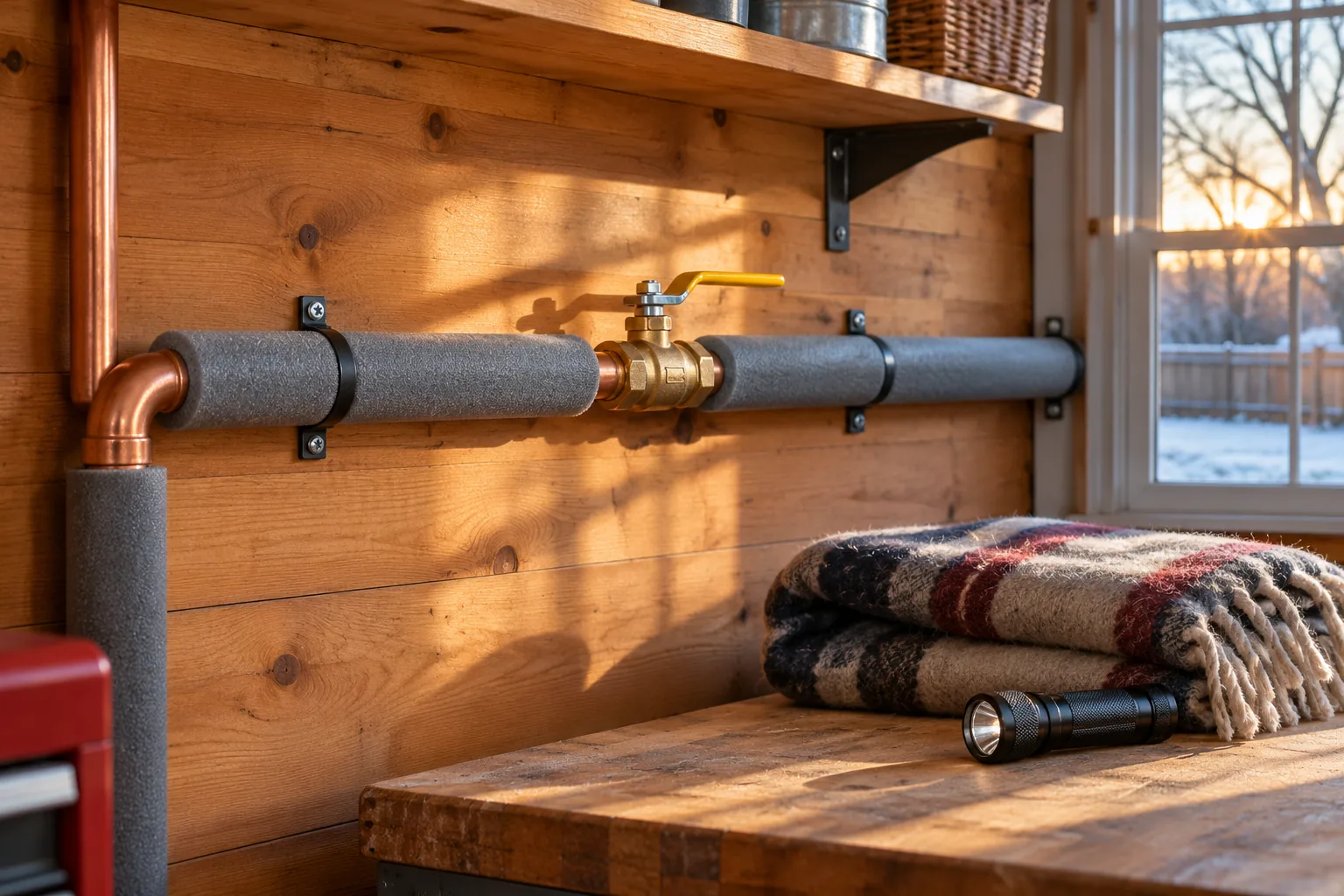
- Wrap exposed pipes in unheated areas, including the attic and a garage washer line
- Remove hoses and wrap outdoor faucets
- Drain and turn off the sprinkler system
- Turn off water to a washer in an unheated garage
- Know where your shutoff valves are, indoors and out
- If you leave before a freeze, shut off the water at the main and leave the heat on
- During a freeze, open sink cabinets so house heat reaches the pipes
- Drip hot and cold faucets or run them before bed, following any local water-use instructions
Two additions from our side. First, take photos of what you did. Wrapped pipes and open cabinets take ten seconds to photograph and can matter later. Second, write your main shutoff location somewhere everyone in the house can find it. A burst pipe at 3 a.m. is not the moment to search for the valve.
What to do in the first hours after a pipe bursts
- Shut off the water at the main. TDI says to do this if pipes freeze, so broken pipes do not leak into the house when they thaw.
- Stay clear of electrical hazards. Avoid standing water near wiring or outlets. If the area is unsafe, leave it and get professional help.
- Photograph and video everything before cleanup. Include the pipe, the water, ceilings, floors, and belongings.
- Prevent further damage. TDI's claims steps say to do what you need to keep damage from getting worse and to make temporary repairs. Keep every receipt.
- Call your company or agent as soon as possible.
- Do not throw away damaged items until the adjuster sees them. TDI says this directly. Move them to a garage or covered area if you must.
- Do not make permanent repairs before the company sees the damage. Temporary repairs are expected. Permanent ones can wait.
After a widespread freeze, a contractor may take longer to arrive. Ask your insurer what temporary measures it recommends. Record who you spoke with and keep a separate list of mitigation costs.
Deductibles, depreciation, and the math nobody likes
Even a covered burst pipe is paid after your deductible. If your all-other-perils deductible is 1 or 2 percent of the dwelling limit, a minor leak may come in under it. Our deductible guide walks through how percentage deductibles work.
How you are paid also depends on valuation. TDI's disaster FAQ explains that on replacement cost coverage, the first check is usually actual cash value. The rest follows once you start repairs and show proof. If you have a mortgage, the check may go to your lender, which must contact you within 10 days of receiving it. Our replacement cost versus actual cash value guide covers that sequence.
For example, if the covered estimate is $5,000 and the applicable deductible is $2,000, the difference is $3,000 before depreciation, limits or other adjustments. Check which deductible applies to water damage. A wind or hail deductible shown on the same page may be different.
Renters and condo owners
Renters are not left out. TDI's winter page says to ask whether your home or renters policy covers sudden and accidental water damage. Most renters policies cover certain kinds of water damage to your belongings. The building itself is the landlord's responsibility and the landlord's insurance. Our renters insurance guide covers what that policy does and does not do.
Notify your landlord promptly in writing and follow your lease’s notice instructions. Separately, contact your renters insurer about damaged belongings and any temporary housing. Texas Property Code §§ 92.052 and 92.054 address repair duties and how an insured casualty may affect the repair period. Seek legal advice if repairs stall or the home is unsafe.
Condo owners face a split between the association's master policy and their own unit policy. Which policy pays for a burst pipe inside your walls depends on the declaration and both policies. Pull both before winter.
Your rights if the claim stalls
Keep the date the insurer received your notice, the date you supplied its requested documents, and any written extension. Those dates matter for different deadlines under Texas Insurance Code Chapter 542. Ask which deadlines apply and whether a catastrophe extension is in effect.
If a claim is denied, the company must say why in writing. You can call the TDI Help Line at 800-252-3439. Asking TDI for help does not pause any deadline in your policy or under the law.
Questions to ask your agent before winter
- Which form do I have, and is freezing a covered peril on it?
- What does my policy require of me to keep freeze coverage, heat or draining?
- How many days of vacancy does my policy allow, and is any property I own at risk of crossing it?
- Does my policy cover tear-out to reach a leaking pipe?
- Is mold cleanup and testing covered, and up to what limit?
- What is my deductible on a water claim, flat dollar or percentage?
- Is my dwelling settled at replacement cost or actual cash value?
- If I rent the property out, should it be on a landlord form instead?
Frequently asked questions
Does homeowners insurance cover frozen pipes that burst in Texas?
Often, yes. TDI says many policies pay for damage to your house caused by a frozen pipe that burst, but there may be limitations. Sudden and accidental water damage is the usual coverage that applies.
Can an insurer deny a frozen pipe claim if I left the heat off?
It can be a problem. TDI warns that home and renters policies might not pay for frozen-pipe damage if you did not take steps to protect your pipes, such as keeping the heater on. Read your policy's freezing wording.
Does flood insurance pay for a burst pipe?
No. TDI states that flood insurance does not pay for damage caused by burst pipes. That is a homeowners or renters policy question.
What if my house was empty when the pipes froze?
Be careful. TDI's 2018 report lists freezing pipes while the house is unoccupied among common exclusions, and policies also limit coverage after a stated number of vacant days.
Will my policy pay to fix the pipe itself?
Not necessarily. Coverage for the resulting water damage and coverage for the failed pipe or the cost to reach it can be treated differently. TDI does not publish one rule, so check your form.
How fast do I need to report a burst pipe?
As soon as possible. TDI says to tell your company quickly, and that hidden water damage usually must be reported within days after you first see it.
Where Argo fits
Before the next freeze, request an Argo policy review. Have your declarations page and endorsements handy so we can help you locate the freezing provision, water deductible, and settlement terms. For other common gaps, see what homeowners insurance does not cover.
This is general information, not legal advice. Texas homeowners forms are company-filed and vary, and the policy issued to you controls what is covered.
Related resources
How Argo can help
Not sure how this guide applies to you? A licensed Argo agent can review your situation in English or Spanish.
- Review your current policy or insurance requirement
- Explain coverage choices, limits, and deductibles
- Help you start a quote or plan the next step