
Commercial Auto vs. Personal Auto Insurance in Texas
Short answer: a personal auto policy is written for personal driving. Once the vehicle is used to earn money, is titled to a business, carries tools and materials to job sites, or is driven by employees, the personal form usually stops responding. The gap does not show up until a claim, and by then the decision has been made for you.
This is the most expensive assumption a Texas small business owner can make. It costs nothing to be wrong about it until the day it costs everything, because a denied liability claim is not just an uncovered repair bill. It is a lawsuit you are defending personally.
This guide covers commercial auto vs personal auto in Texas: where the line sits, what triggers a commercial policy, and what happens when the two get mixed up. If you already know you are on the wrong side of it, start a business insurance review.
What a personal auto policy is built for
A personal auto policy is priced and underwritten around an individual driving for personal reasons. That includes commuting to and from a regular workplace, which surprises people who assume any work-related driving is excluded.
Generally within scope:
- Commuting to a fixed job site or office.
- Personal errands and family driving.
- Occasional incidental business driving, such as a sales representative driving to a client meeting or picking up office supplies.
Generally outside scope:
- Carrying goods or people for a fee.
- Hauling tools, materials, and equipment for a trade.
- Driving by employees on company business.
- Vehicles owned by a business entity.
- Any use that would require commercial liability limits under a contract.
The Texas Department of Insurance's auto insurance guide describes the standard coverages a personal policy contains. What it does not contain is a named insured that is a company, and that alone is often the deciding factor.
The triggers that move you to commercial
You likely need a commercial auto policy if any one of these applies. It only takes one.
Ownership by a business entity. The vehicle is titled or registered to an LLC, corporation, or partnership. A personal policy insures a person. If the business owns the vehicle, the business needs to be the named insured, and a personal policy generally cannot do that.
Employees driving. Anyone other than you or a household member drives the vehicle for work. Employee driving creates vicarious liability for the business, and personal policies are not designed to insure a company's exposure to its employees' driving.
Transporting goods or people for a fee. Delivery, courier, rideshare, and passenger transport. This is the most common denial scenario in Texas.
Hauling tools, materials, or equipment. Plumbers, electricians, HVAC techs, landscapers, and remodelers carrying trade equipment to job sites. The presence of a commercial load changes the character of the use.
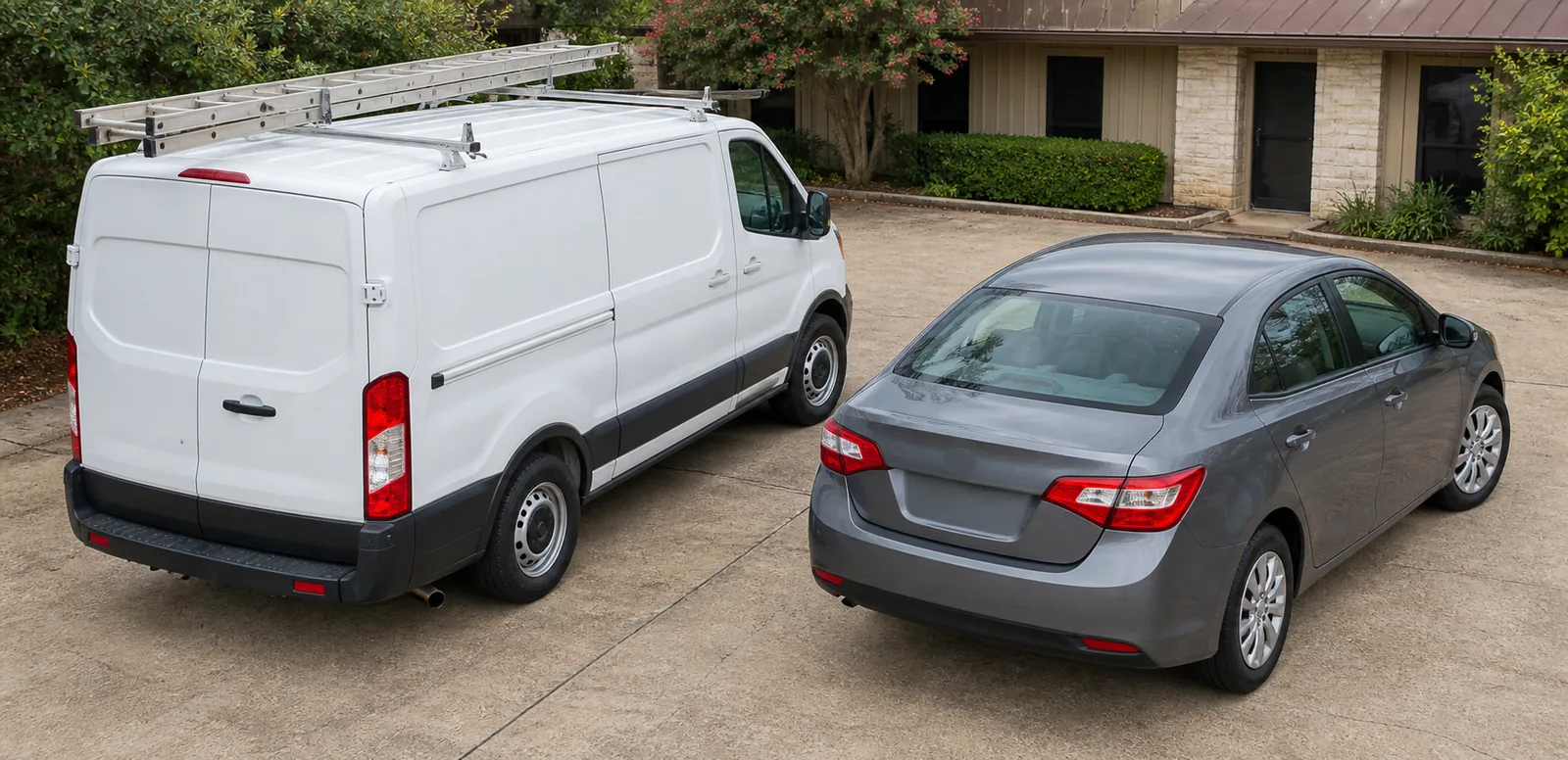
Vehicle modifications. Ladder racks, permanent toolboxes, utility beds, lift gates, and permanent business signage or wraps. These are visible evidence of commercial use, and an adjuster will see them at the scene.
Contract requirements. A general contractor, property manager, or municipality requires $500,000 or $1,000,000 in auto liability, or requires additional insured status. Personal policies generally cannot meet those terms or produce a compliant certificate.
Weight or vehicle class. Larger trucks, box trucks, and units above certain weight ratings fall outside personal auto eligibility entirely.
The narrow exception people over-rely on
Some personal policies do allow limited incidental business use, sometimes referred to as artisan or business-use-permitted classification. It typically contemplates a professional who drives between appointments: a real estate agent showing property, a consultant driving to a client site, an outside sales representative covering a territory.
The exception is narrower than most people assume. It generally does not stretch to cover:
- Carrying trade tools and materials.
- Delivering anything for compensation.
- Transporting clients or passengers for a fee.
- Driving by employees.
- Vehicles with commercial modifications.
Two practical cautions. First, whether your policy permits incidental business use is a policy-specific question, not a general rule, so read the declarations page or ask your agent to confirm in writing. Second, even where it applies, the liability limits available on a personal policy are usually well below what a commercial contract requires.
What actually happens at claim time
This is the part worth understanding precisely, because the failure mode is not a slightly reduced payment.
An adjuster investigating a serious loss will establish what you were doing when it happened. Sources include the police report, your own statement, dispatch and app records, invoices, GPS and telematics data, photographs of the vehicle showing racks or signage, and the contents of the vehicle at the scene.
If the investigation establishes business use that the policy excludes, the likely outcomes are:
- The liability claim is denied. The injured party's medical bills and vehicle damage become your personal responsibility, and you defend the lawsuit at your own cost.
- Your own physical damage claim is denied. You repair or replace the vehicle yourself.
- The policy may be rescinded or non-renewed if the application misstated how the vehicle is used.
- Your business has no coverage at all, because the business was never a named insured on the policy.
There is no partial credit here. Personal assets are exposed because the business entity that was supposed to be the liability shield was never insured.
What commercial auto adds
Beyond simply responding, a commercial auto policy is structurally different in ways that matter.
The business is a named insured. This is the core difference. The entity that gets sued is the entity on the policy.
Higher liability limits are available. Commercial auto is commonly written at $500,000 or $1,000,000 combined single limit, and a commercial umbrella can sit above it. Personal auto limits are usually far lower.
Coverage symbols define scope. Commercial auto uses numbered symbols to define which vehicles are covered. Symbol 1, any auto, is the broadest and covers owned, hired, and non-owned vehicles for liability. This flexibility does not exist on a personal policy.
Hired and non-owned auto coverage. This handles employees driving their own cars on company business and rented vehicles in the company's name. It is one of the most commonly missing coverages in small business programs, and it is often inexpensive to add.
Additional insured and certificates. Commercial policies can be endorsed to add a general contractor or property owner as additional insured, and can produce a certificate that satisfies a contract. Note that under Texas Insurance Code Chapter 1811 a certificate can only state what the policy actually provides, so the endorsement has to exist first. The Texas certificate rules explain how that works.
Business property in the vehicle. Tools and equipment in a work truck are generally not covered as personal property on either policy. They belong on a contractors tools and equipment or inland marine policy, which is usually written alongside commercial auto.
The cost question, answered honestly
Most owners avoid the conversation because they assume commercial auto is dramatically more expensive. Sometimes it is. Often, for a single pickup or van driven locally by an owner with a clean record, the difference is smaller than expected, and the commercial policy delivers materially higher limits and insures the business itself.
What actually drives commercial auto pricing:
- Vehicle type, weight, and value.
- Radius of operation and whether you cross state lines.
- Driver records for everyone who will drive.
- Liability limit selected.
- Industry classification and what you haul.
- Loss history.
- Whether physical damage is included and at what deductible.
TDI notes that the state does not set premiums and that rates vary by company, which is why the same vehicle can produce very different quotes. Its guidance on how auto insurance costs are calculated is worth reading before assuming any number.
The only honest way to answer the cost question is to quote it. Comparing an assumption to a real number is not a comparison.
Rideshare and delivery: a special case
App-based work sits in an awkward middle. A personal policy typically excludes driving while logged into a delivery or rideshare app. The platform usually provides some coverage, but often only during specific phases of a trip and frequently with a high deductible and no coverage during the app-on, no-passenger period.
Three paths, in increasing order of coverage:
- A rideshare or delivery endorsement on your personal policy, offered by some Texas carriers, which fills the gap phases.
- A commercial auto policy, appropriate for higher-volume or dedicated delivery work.
- Nothing, which is the default many drivers are on without realizing it.
If you drive for an app, confirm in writing which endorsement your carrier offers and what phases it covers.
Industry by industry: where the line usually falls
The general rules are easier to apply against real occupations.
Trades: plumbing, electrical, HVAC, roofing, landscaping. Almost always commercial. The vehicle carries tools and materials, frequently has a rack or utility bed, and job-site contracts routinely require $1,000,000 in auto liability plus additional insured status.
General contractors and remodelers. Commercial, and usually alongside general liability and a tools and equipment policy. Contract requirements drive the limits more than the vehicle does.
Real estate agents. This is the most common legitimate use of the incidental business use exception. An agent driving to showings in an unmodified personal car is frequently fine on a personal policy with business use disclosed. It changes if the agent is transporting staging furniture or has a wrapped vehicle.
Property managers and maintenance techs. Commercial once tools, parts, or turnover supplies are being carried, and almost always once the vehicle is titled to the management company.
Food delivery and rideshare. Outside standard personal coverage. Either an endorsement or a commercial policy, depending on volume and carrier appetite.
Couriers and medical delivery. Commercial. Transporting goods for a fee is the clearest trigger there is.
Mobile services: detailing, pressure washing, pet grooming, notary signing. Commercial once equipment is carried or the business owns the vehicle. Notaries and consultants who only carry a laptop are closer to the incidental exception.
Nonprofits and churches with vans. Commercial, and passenger vans carry their own underwriting considerations because of the occupant exposure.
Farm and ranch. Often a separate farm auto classification rather than either standard form.
If your occupation is not listed, the test is unchanged: does the vehicle earn money, carry commercial cargo, get driven by employees, or belong to a company.
What happens to the vehicles you do not own
Two coverages get missed constantly, and both live on the commercial side.
Hired auto covers vehicles the business rents, leases, or borrows. If you rent a truck for a job in the company's name, personal auto generally does not follow it.
Non-owned auto covers employees driving their own vehicles on company business. This one surprises owners: if an employee causes an accident while running a company errand in their own car, the injured party can pursue the business. The employee's personal policy responds first, but the business is exposed above it, and the business has no coverage of its own unless non-owned auto is in place.
Both are usually inexpensive to add because they sit excess of the vehicle owner's coverage. For a small business with even one or two employees running errands, they close a gap that would otherwise be funded out of the company's assets.
How to fix it without drama
- Write down how the vehicle is actually used. Miles, cargo, who drives, how often, and whether anyone pays you for the driving.
- Read your declarations page for a business use classification or exclusion.
- Check the title. If the vehicle is in a business name, that alone usually forces the issue.
- Collect your contracts. Any required limits or additional insured wording determines what you need to buy.
- Get a real quote rather than estimating. The number is frequently lower than assumed.
- Do not wait for a renewal date. Coverage can be moved mid-term, and the exposure exists every day until it is.
Disclosing business use is not an admission that costs you money. Non-disclosure is what costs money, because it converts a covered claim into a personal liability.
Where Argo fits
Argo Insurance writes both personal and commercial auto across multiple carriers, which means the honest answer is available: sometimes an endorsement on the personal policy solves it, and sometimes only a commercial policy will. A captive agent can only offer one company's version of that answer.
Tell us what the vehicle is, who drives it, what it carries, and what your contracts require. Request a commercial auto quote or a full business insurance checkup if you are not sure which side of the line you are on.
Coverage descriptions here are general. Whether a specific claim is covered depends on the policy language, endorsements, and facts of the loss.
Related resources
How Argo can help
Not sure how this guide applies to you? A licensed Argo agent can review your situation in English or Spanish.
- Review your current policy or insurance requirement
- Explain coverage choices, limits, and deductibles
- Help you start a quote or plan the next step